
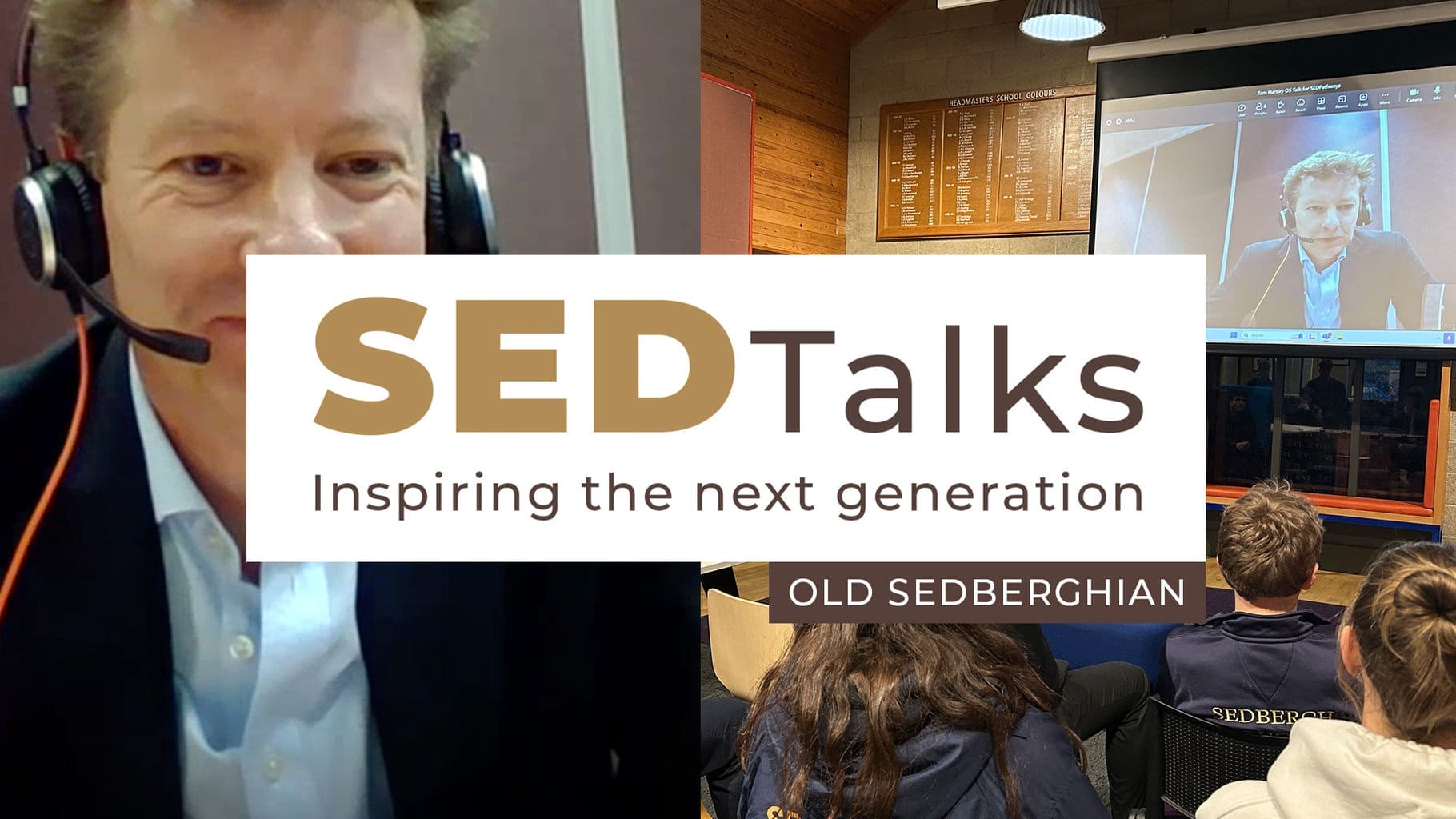
This presentation was part of our 2024 Pathways Programme. Access additional resources and Old Sedberghian professional profiles at the Old Sedberghian Club, OS Connect.
Tom Hartley (Evans House 88-93) completed A levels in history, geography and economics and went to Northumbria University. While not really certain what he wanted to be, he spent a placement year from University working in London as an accountant. Although he realised pretty quickly that accounting wasn’t a career he wanted to persue, it was during that time that he became curious about working in a mythical place called “The City” and discovered an interest in investments – specifically, the area of private client investment management. After a spell doing work experience he was confident that he’d found what interested him. He joined Brewin Dolphin in May 1999 and is now Divisional Director – Investment Management.
Tom is keen to express how grateful he is for the “enormous amounts of assistance” he has received from Old Sedberghians helping him on his journey; both in terms of when he was thinking about a career in wealth management and then subsequently when he’s met Old Sedberghians as part of his networking, a key aspect of what what he does when developing business opportunities.
I have some clients that have been with the firm for many, many years. So, I know families really well and that’s at the heart of what I do. Essentially my role is to manage private clients individual portfolios and we give really personalised financial advice; growing their money, preparing them for retirement, preserving their lifestyle and passing on wealth to different generations.
If we look back at really the last 25 years since I joined Brewin Dolphin, I would call myself a stockbroker. The information about companies, information about the internal workings of businesses was held by a small group of people in the city. Technology has totally changed that and that information is freely disseminated. There is enormous amount of propriety research which takes place within the city about companies, about the prospects for companies, about how companies are doing, and what’s the best company to buy in certain sectors. People in jobs like mine have morphed from being stockbrokers to investment managers to what we describe now as a wealth manager.
Financial planning is a really interesting area and encompasses really four key areas, retirement planning, trust and estate planning, taxation and protection. We all understand what retirement planning is; that’s putting money aside for your retirement to make sure you have enough income. Trust and estate planning is for people who have generated capital and have significant wealth and they want to pass that down to the next generation in a tax efficient manner. Taxation is again self-explanatory, trying to take advantage of all the legal ways which we can preserve and grow capital in the tax efficient manner. Protection is looking at trying to ensure that when you are younger and you have children that you are protected against critical illness and, sadly, death. So we try and make sure that people have got enough insurance in place that their loved ones are protected in the event of something untoward happening to them.
What I specialise in is discretionary investment management; discretionary meaning where clients essentially devolve the responsibility for the management of their assets to someone like me. That is where I build investment portfolios with a variety of different asset classes. We spend a lot of time trying to understand the needs of our clients. A typical financial journey starts when someone is young – at your age you’re not starting earning yet, but as you start earning, you should start thinking about maybe investment planning; putting aside some money – and I could spend a lot of time advocating the advantages of early money and investing – that’s for another conversation. You can see as people get towards retirement then they’re looking at their earnt income will be probably declining. They’re not working but they’re looking to essentially draw on their planning which has taken place. You can see the key thing there, the word planning is used many times. So we spend a lot of our time talking to clients, understanding their needs, their objectives to be able to put in place something which is a credible plan for their risk tolerance.
What I do is try and build really trusted long-term relationships with clients to understand what they’re really looking for. They may have inherited money, I’ve had a couple of clients who’ve who’ve won the lottery, some have received money from a previous generation, they may have sold a business which they worked through all their life. So this is trying to understand what are their needs, what will they need income for from that investment portfolio, do they want to pass it on, do they want to continue to grow it? Are they actually in their twenties or thirties and wanting to look at that pot of capital growing at a reasonable rate per year to provide them with enough security to retire at a certain point in time? So, that’s really the initial work and then it’s developing that plan and then moving on to developing that investment portfolio, which is really my key area and what I spend my day dealing with. And then it’s constantly reviewing it.
So we come to the crux of investment and the crux of our approach is preserving capital relative to inflation; if you put all your money in cash and it generates a 5% return, but inflation’s running at 10% means that the capital is eroding. It’s a bit of like an ice sculpture melting. You don’t actually see it really, but your money is eroding all the time relative to inflation. You’re probably aware – inflation has been really topical over the last two / three years – for a long period of time since the financial crisis in 2007, inflation’s been running at 2% and suddenly, after covid, there’s been a period of time where it went up to approximately 12%. It’s coming back down now. But inflation has had a profound effect on financial markets and the pricing of all asset classes because interest rates have had to go up quite significantly from the very low rates pre 2022. The effects of that inflation are that a £100 today, if we essentially have 10% inflation, it would be worth seven £7.18 in 25 years. So, at the heart of what we’re trying to do is we’re trying to protect the capital against inflation. What we come onto is investing for the long term.
When I was at university and was thinking about a career in wealth management, I watched films like Wall Street and read Nick Leeson’s book on trading and I got quite captivated by that sort of life. I was thinking, ‘Wow, it’d be quite fun to be on a trading floor’. In films you saw these people shouting and things looked quite exciting actually. What you realize quite quickly is that those who focus on the very short-term tend to actually lose a lot of money. And those who focus on long-term investing are the ones who actually are the silent winners really. If we spend time looking back at history, looking at empirical evidence, it shows that actually long-term investing is the right approach.
There are five or six key asset classes which we use to construct investment portfolios. This gives us essentially six core risk categories, and coming back to that point about developing that relationship with the client – it’s understanding their needs, their aspirations, and also their attitude to risk. We scientifically test that by asking clients to complete questionnaires which gives us a sense of their attitude to risk, and it gives us a sense of a starting point in terms of how would they feel about different risk categories. It probably goes without saying that the higher risk categories, over the last 10 years, have performed a lot better than our lower risk categories, but there’s a lot more volatility.
So the portfolios are moving month-by-month. So just really coming on to what my day to day job is really is that we are spending our time looking at the economic and business cycles and coming back to that number one – protection against inflation. But what we like to do is, we are active in our management of portfolios and you may have read about debates between active investing and passive investing. Passive investing is essentially just buying tracker funds, which just tracks the FTSE100, it tracks the S&P 500, but it tends to just give you market performance. What we are trying to do is outperform benchmarks. So we spend our time looking at different sectors, different companies – building the list. We’re balancing the risk and return and then asset allocation, making decisions whether to buy more in bonds, more in cash, more in equities. And we’re constantly tinkering with our asset allocation to try and generate returns for our clients which beat the market.
There’s very different mandates across my client base, but we are really well supported in terms of research. Now we come to different roles and responsibilities. We’ve got people like myself who are client facing, but we’ve got a huge number of people who spend their time just researching; you’ve probably heard of analysts and strategists? Those are interesting roles. They’re not necessarily client facing, but they tend to provide the likes of me with a huge amount of information. Although no two days are the same, I start the day with a morning call with our research team which will update us on what’s happened over night in markets, the companies which we follow, which have reported, what the numbers are – because we spend our time worrying about what companies are saying to us rather than what the market reaction is. A company might have some really good news, but the share price may be down 5% for a particular reason. We want to know why. So we have a half an hour call which goes to all our offices. Then it’s communicating with clients, talking to clients, but it’s also making changes to portfolios or a client may say, I want money out, I want to buy a new car, how would I raise that capital? So it’s constant dialogue with clients and what comes from that is those really strong trusted relationships you have with individuals.
You’ll be surprised to know that we spend a lot of time worrying and thinking about stewardship and ensuring that because we are one of the biggest private client investment managers in the UK running just over 50 billion, we have a huge responsibility to make sure that we’re acting in a responsible manner. So we vote on behalf of our clients, but we’re also engaging with companies in terms of making sure that we’re helping them formulate their strategy. We take that very seriously. And then coming onto the ESG side, we overlay all of our investment recommendations with an ESG (Environmental, Social and Governance) lens as well to make sure that we are focusing on buying companies which have got an ESG angle to them and they are acting in a manner which we would hope they would be on behalf of all their stakeholders.
I want to talk now about the characteristics which we look for in young investment managers. From our side of things, we have three core values; genuine, expert and ambitious. We look for really genuine people, people who care passionately about their clients, care passionately about making sure that we interpret their investment mandatescorrectly. The expert is knowing your investments, knowing the areas which you can help your clients with. So, I’ve been here nearly 25 years and I’m on that lifelong learning journey, which is so important and something which I think is sometimes forgotten. We’re looking for people with huge ambition. We have ambition for our clients but also ambitions for oneself and the business. So, I would sum up by saying if you’re genuinely interested in people and curious about world affairs, companies and markets, it’s a great career.
In terms of qualifications, I think it’s a little bit different now, for me I went on a three year journey to develop and gain my professional qualifications. In terms of career progression, I look back on my time and I always think actually I was quite patient – that’s important, actually learning to put what you’ve learned into practice – you have to learn markets, you have to go through experiences which are quite challenging. It’s not very nice to say you bought a stock and it’s down 50% and you have to explain why, but that actually part of the learning curve and that’s really important as you go forward in your career. Some of the younger generation are very keen to progress and manage more and more money, but actually we realize that it’s really important to go through that cycle.
Conclusion
Looking back at the past 25 years since joining Brewin Dolphin, the transformation in the financial industry has been remarkable. With technology revolutionising information dissemination, roles have evolved from stockbrokers to investment managers to wealth managers. Financial planning encompasses crucial areas like retirement planning, trust and estate planning, taxation, and protection, all aimed at securing one’s financial future. My specialisation lies in discretionary investment management, where understanding clients’ needs is paramount. We craft investment portfolios tailored to their risk tolerance and long-term goals, actively managing assets to beat the market. Stewardship and ESG considerations are integral to our investment philosophy, ensuring responsible and sustainable practices. For aspiring investment managers, qualities like genuineness, expertise, and ambition are vital, coupled with a commitment to continuous learning. Qualifications such as the Securities Institute diploma in investment management lay the foundation for a rewarding career.