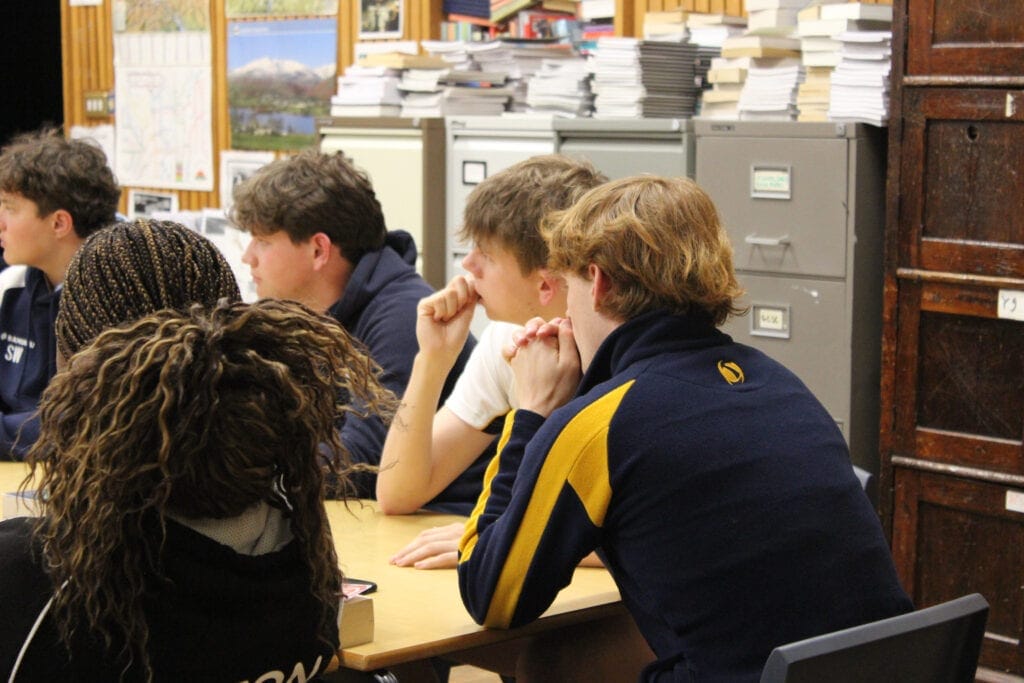
The School of Athens is a pupil-led academic society that challenges pupils to present and defend their thoughts in a supportive group of peers. More information is available on our School Societies.
This week, Year 12 pupil Jack has chosen a topic of personal interest to him and his aspiration to undertake an engineering degree. With ChapGPT frequently in the news, Jack’s presentation captured imaginations and raised a lot of questions. Below is a summary of the presentation and highlights from the audience’s many questions and opinions.
Humans vs Robots: Who Deserves the Job?
While some people believe that robots and artificial intelligence (AI) can solve many problems and make our lives easier, others may be concerned that they may take over jobs, become uncontrollable, or even pose a threat to humanity. So how can automation benefit our society?
Automation and AI can benefit our society if integrated correctly:
- Some job sectors and workplaces can benefit from increased efficiency that enables quick completion of monotonous tasks; increasing workers productivity and reducing labor costs – allowing businesses to flourish.
- One advantage to the use of robots is that they don’t require breaks like human workers and can work unsociable hours.
- Other opportunities for robots and AI is in performing dangerous tasks in hazardous environments that are unsafe to humans. For example, robots can be used to perform tasks such as handling toxic materials.
- Robots are also useful in industry where a high degree of precision and accuracy is critical. Robots and AI can lead cost savings that reduce the cost of products to consumers and allow companies to remain competitive in rapidly changing markets. Having robots undertake this precision work allows workers to focus on tasks requiring more creative and complex skills.
Many people are familiar with services such as ChatGPT and Snapchat AI which can be accessed by millions of consumers globally. These groundbreaking artificial intelligence services are exciting and have the potential to revolutionise and change the workflow within a great number of job sectors, improving the job set prospects and career opportunities for many people. But what will humanity do with this new technology? Will AI be humanity’s savior or its downfall? So, how can automation damage our society?
While there are undoubtedly benefits to robots and automation, it’s important to carefully consider the potential risks and work that must be put in to develop and deploy these technologies to prioritise human ethics and values.
- As automation is increasingly utilised throughout our society, there is an ever-growing risk of job displacement and economic inequality. With up to 800 million jobs set to be replaced by automation by 2030, this will lead to fewer workers having greater career opportunities while many more people are left behind. Robots are not designed with diversity and inclusion in mind and could perpetrate bias and discrimination in sectors such as hiring, lending, and law enforcement.
- Ethical concerns associated with the use of robots, include the rights to privacy, consent and the rights of the robots themselves.
- Robots also lack simple human qualities which are critical in industries such as healthcare where human decision-making, critical-thinking and judgment are necessary.
- There is an increasingly large risk of social isolation in which people may become more disconnected from human relationships and communities – which has a potential to be extremely damaging to our society.
Overall, the debate about robots replacing jobs is complex and multi-faceted. While there are certainly benefits to automation, it is important to consider the potential downsides and ensure the benefits of automation are distributed fairly across our society. Additionally, it’s important to invest in education and training to help people transition to new industries and ensure that they have the skills to succeed in the changing job market. Otherwise, the use of robots in society could cause an unfair distribution of wealth, leaving many people disadvantaged. Hence, it is necessary to consider all the advantages and drawbacks to robots and artificial intelligence before they are infiltrated throughout our society in order to prioritize human values and ethics.
Highlights from the Post Presentation Audience Discussion, Questions and Thoughts
Eventually people and society will adapt [to robots and AI], but at the moment education needs to adapt faster, because the jobs that are going to be available in 2030 aren’t the same that are available now. So while this is a temporary problem, there will still be a large number of people trained for jobs that no longer exist. So there will be unemployed people who’ll have to retrain to then get a job later on.
I think ChatGPT is just the start. I think this is something that’s going to replace essentially everything. In the next seven years, there will be mass change, it won’t necessarily mean that everyone’s going to be displaced, but I think it means that a large number of people are and that there will also be demand for educating people to run these programs.
In finance, where there is a lot of quantitative data, numbers and figures, I think AI could massively change the game. Especially in analysing the financial state of the company and roles like this, AI could provide a huge opportunity for companies to get economic and financial information.
I don’t think AI will affect some sectors, such as medicine. In medicine, for example, I don’t think you can necessarily have an AI system diagnosing you. I think you require human qualities within that sector. I’m also not sure how much you would want to be operated on by AI.