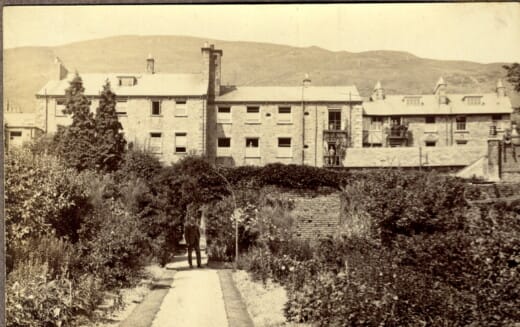

History of Sedbergh School in 50 Objects #5: Evans House


Evans House has played a significant role in Sedbergh’s history, elevating the School from a parochial day school to a note-worthy boarding school offering a high standard of education to pupils drawn from a wide geographical area.
Christopher Hull, Headmaster, 1782-1799, bought the central part of what is now Evans House in 1784 to be his private home. Seeking to supplement his modest income Hull accepted pupils for ‘bed and board’. This initiative extended the potential pool of pupils who might be educated at Sedbergh. Children no longer needed to live within an easy day commute of the school to benefit from its teaching. Mr Hull’s house quickly filled beyond capacity and additional boys boarded at private lodgings in the town. Hull was popular with the boys, less so with the Governors. The early twentieth century school historian Lowther Clarke noted that Hull was known for his excellence as a mathematician, but ‘incompetency to teach Latin and Greek’. A former pupil, Canon Shepherd recalled that on fine days Hull would ask his charges,
“Boys, which would you like to do? Stay in and work, or go shooting on the Riggs?”.
Unsurprisingly, his pupils elected to spend as much time as possible out of the classroom.
Hull died in post in 1799, collapsing in the street. The school Governors purchased the house to be used as the formal Headmaster’s residence. It retained this function until School House was built some eighty years later. Since then, Evans has been a boarding house. As was established practise at the time the name of Evans House varied with the name of the Housemaster; for example, under the Revd Mackie it was known as Mackie’s House and its members as Mackieites.
In 1908 the Governors decided to give the Houses fixed names. The new name decided upon was Evans House, in memory and honour of John Harrison Evans, Headmaster between 1838 and 1861. Evans was a formidable scholar who encouraged boys to study hard outside the classroom, thus exceeding the limits set by formal teaching. More than 50% of boys he taught at Sedbergh went on to Oxford and Cambridge. Evans was a generous man. On retirement he was given a sum of money collected by former pupils which he chose to donate to the town of Sedbergh to build a market hall and reading room. This is now the public library.
Over the years Evans House has been extended, taking in surrounding buildings, including the Cross Keys Inn, a bank, a croft and Cockle Street properties. For a while, the town’s fire engine was kept in the garage.
Sedbergh folk law tells of a secret underground passageway that used to link the neighbouring St Andrew’s Church with the basement of Evans House from its days as an inn. Bonnie Prince Charlie is reputed to have used the passageway to evade capture during his retreat from the Battle of Culloden. Despite attempts by subsequent generations of Sedberghians the secret passageway has never been uncovered.
One of the most notorious Evanians is perhaps Leslie Duckworth (Evans 1905 – 1910). Duckworth was a keen shooter and a member of the School’s Shooting Eight from early in his Sedbergh career. Leslie’s room had a clear view of the St Andrew’s Church clock tower and so one day, from his bedroom window, he used an air rifle to shoot the hands off the church clock, and take pot shots at the weathervane, causing substantial damage. Leslie was summoned to the Headmaster’s study to be expelled, however the shooting master burst in to the room and rushing over to the Headmaster, whispered audibly in his ear that it was Bisley, the annual Public School shooting competition ‘…next week Headmaster’ and that the school had a good chance of winning the Ashburton Shield that year.
The Headmaster apparently paused, cleared his throat and stated that Duckworth would have a beating and a final warning this time. Duckworth was saved from expulsion, went to Bisley and won a silver medal in the Spencer competition which can be seen in the School Armoury alongside a photograph of the team.
Evans House colour is yellow. It is represented by a wasp symbol, and the house magazine has been The Wasp, and occasionally ‘The Evanian.’