
History of Sedbergh School in 50 Objects #6: First Governors Minutes


Following a sad decline in the School’s fortunes under Headmaster Henry George Day, and the perennial problem of distant governance from St John’s College, Cambridge, a radical change was needed to restore the School’s fortunes.
Pupil numbers had dropped to just 10 boys in 1865 and a Charity Commissioners’ report proposed that the endowments of Sedbergh and Giggleswick should be amalgamated to create ‘a large “first grade” school either at Giggleswick or at some more convenient and central situation’ – not, that is, at Sedbergh. This plan did not meet with support by those in authority at Sedbergh.
After complicated negotiations with the Endowed Schools Commission, ‘Scheme No 243’, dated 20th October 1874, was approved, recording the scope and management of ‘The Free Grammar School of King Edward VI in Sedbergh in the County of York’.
The Scheme removed the right to appoint the Headmaster from St John’s College, Cambridge, and vested it in the Board of Governors. This ended, at last, the hazardous practice of nominating from afar an individual whose academic credentials might be impeccable, but whose suitability for the office of schoolmaster was far less certain. Governors were also granted the right to dismiss the Headmaster, with the process required by Governors laid out clearly.
The Scheme detailed that the Governing body was to be made of at least seventeen Governors, largely drawn from named institutions, and outlining the duties of both the Governors and the Headmaster of the School.
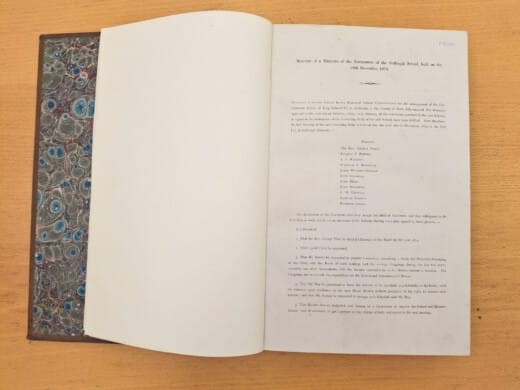
The newly formed governing body met for the first time on December 10th 1874 in ‘The Bull Inn, Sedbergh’, with minutes of the meeting written by the elected Chairman of the Governors, George Platt. The governors were keen to survey the assets of the school. The inaugural minutes recorded that, ‘Mr Inman be requested to prepare a statement describing – firstly, the Properties belonging to the Trust, with the rents of each holding, and the average Outgoings during the last five years; secondly, any other Investments, and the Income derived from each; thirdly, amount at Bankers’. The governors clearly wanted to understand the full picture of the School’s fortunes, or lack thereof.
At the first meeting it was determined that an interim Headmaster be appointed immediately, and that pupils be given a terms notice that fees were to be raised to £1 per term, with an Entrance Fee of five shillings. Attention was also paid to the calibre of pupils admitted with the instruction that all prospective pupils must apply formally for admission to the School, and that the application forms used at Giggleswick would be ‘adopted’ for this purpose. It was also agreed that arriving pupils must be examined. 11 governors were present at the meeting, including Francis Sharp Powell, later the influential Chairman of the Governors and generous benefactor to the School.
The Governors minutes, a most vital record of the history of the School, now span over 150 years, recording in detail the changing fortunes of Sedbergh. The careful and considered planning that took place in preparation for seismic changes is recorded objectively, but these bound volumes also offer insight in to how Sedbergh was addressing developments in the wider world. The arrival of electric light to a small number of buildings in 1910 is approached with hesitation, as was discussion of whether the school should purchase ‘sound apparatus’ to supplement the School’s cinema equipment following the introduction of ‘talkies’ – the Headmaster felt that ‘it was quite possible that it would not be needed’, such was the belief that ‘talking pictures’ would be a flash in the pan rather than a permanent change in Hollywood’s offering.
The meeting minutes include regular letters from the School Medical Officer about the health of the School, offering insight into epidemics, developments in hygiene and changing societal expectations. The letters from the Headmaster detail fluctuating pupil numbers, successful Oxbridge candidates, staffing changes and minutia on the successes and challenges facing the School each term.
The School Governors continue to play a vital role in the running of the School today. The carefully selected Governing body bring a wide range of skills from across a number of industries and disciplines, generously offering their time for free in the interest of maintaining a thriving School.
The implementation of Scheme 243 and creation of a governing body marked a pivotal moment in the history of the school. With management moving away from St John’s to an appointed governing body, the school at once had the capacity to react quickly to challenges and opportunities, without the ties of distant and often ineffective oversight from Cambridge, or the restrictive 16th century letters patent.