
History of Sedbergh School in 50 Objects #19: Powell Hall


Heppenstall’s ambitious plans for the Victorian rebirth of Sedbergh School featured an expansive central meeting space at the heart of the School. He did not live to see his full vision realised, but Henry George Hart and Francis Sharp Powell picked up the baton after Heppenstall’s death, and saw his plans to fruition.
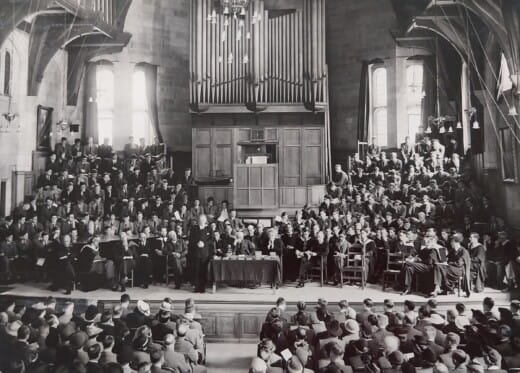
Powell Hall was completed in 1906, funded predominantly by Chairman of the Governors Francis Sharp Powell. Powell subscribed £3,000 to the building, with the remaining costs largely contributed by Mr Hart, Mr Wilson and other members of the ‘Old Gang’ of masters. During Sir Francis’ school days (1843 – 6) the full extent of the School was the library building where all classes were held, and the Headmaster’s house, known as Evans House, where boys boarded. The new hall had an immediate impact on school life, providing opportunities for pupils and staff to perform to the full School for the first time. The first music to be heard in the hall was ‘God Save the King’ with a treble solo, sung by R. E. Atkinson, for the first verse.
From the very beginning the hall provided opportunities for the School to come together. Daily assembly moved to Powell Hall which swelled with the sound of 250 boys and masters, raising their voices to sing familiar hymns. The initial fittings of the building included a stage with tiered seating. This stage area was enlarged during the 1960’s. The initial plans made provision for an organ to the rear of the stage, however this was not installed until 1919, after the first world war. The organ was overhauled in 1983 and is again in need of similar treatment. Sedbergh’s current Director of Music despairs that the hymn choice available for assemblies is severely limited by the diminished power of the organ.
Following the 1918 armistice, the Ridehalgh family funded the installation of oak panelling and a gallery seating area, known as the Ridehalgh gallery, in honour of the five members of the family who did not return from fighting. Above the gallery are sited the Scholar’s honours boards listing Sedberghians who gained a scholarship or exhibition to Oxford or Cambridge Colleges.
Powell Hall remains central to school life. The School has blossomed in recent years and so it is no longer possible to accommodate the whole School and parent body for events such as Speech Day and the Wilson Run concert. However, daily assembly has remained; the full School gathering together to have a moment of reflection and to set the tone for the day. Powell Hall remains the first choice venue for many concerts and performances, transformed to a cabaret lounge for our ‘Jazz and Swing’ night, dripping with glitz and razmataz for the ‘Night at the Movies’ and used dynamically for socials, plays, lectures and film screenings. Many returning Old Sedberghians quake on entering as they recall the intensity of sitting exams under the vaulted ceiling many decades before.
Powell Hall is a place of celebration. Built on a grand scale, the hall has played host to some of the most important moments of Sedbergh’s post Victorian history. The end of World War One was marked with a joint School and town dance in the hall. Sedbergh’s 400th and 450th anniversary celebrations featured dinners and concerts there, and for the 500th anniversary gala weekend the hall was a fitting venue for scenes from the ‘Stages through the ages’ production, and for the ‘Sedbergh 500: A History of Sedbergh School’ exhibition. Powell Hall is a key monument in our Schools history. Testament to the loyalty and generosity of our friends.