
History of Sedbergh School in 50 Objects #18: Egyptian Mummy


In the late 1800’s Sedbergh School was privileged to have a very fine museum on the upper floor of Old School, now the School library. Artefacts were generously donated to create a diverse and culturally significant collection. For 63 years this collection included an Egyptian mummy in a story that sadly ends in shame for the School.
In 1888 a group of pupils were corresponding with Sir Colin Scott Moncrieff, an engineer and civil servant who was at that time working in Egypt repairing the Nile Barrage and coordinating the development of irrigation systems. Sir Colin had an interest in the archaeological digs taking place in Egypt and donated excavated mummies to several major British institutions including the National Museum of Scotland. In response to the interest shown by Sedbergh’s pupils, Sir Colin sent the School a genuine 2000 year old Egyptian mummy.
The mummy was from towards the end of the period when Egyptians mummified their dead. These later mummies were embalmed less well than earlier mummies and so tended to be less well preserved. Sedbergh’s mummy was placed in a simple wooden coffin with little decoration, as was the practice with later mummies. It is likely that the coffin would originally have been decorated with the name of the deceased however this had deteriorated by the time it was excavated. The head of the mummy was covered with a gilt head mask decorated with symbols for safety in the afterlife.
The arrival of the mummy caused great excitement in the School. Visitors from the School and town flocked to the School museum to view this new addition to the collection. A report about the mummy written by Monsieur Gretant, Director of the Public Museum at Cairo was published in the Sedberghian Magazine detailing the origin, age, decoration and embalming process of the mummy. The report states:
‘The mummy found near Illahoun in the Fayoum valley (Central Egypt) belongs to a kind little known as yet, namely to that of the last heathen period.’
The pejorative use of the term ‘heathen’ was illustrative of patronising colonial views held at the time. The removal of a mummy from its homeland was part of that picture. There are now of course different attitudes relating to ownership of discovered artefacts, and the removal of UNESCO designated ‘cultural property’ from their country of origin.
The excitement in Sedbergh continued, with boys writing poems and songs about the mummy. One such poem, an epic spanning 104 lines of rhyming verse, the ‘Ode to the Mummy’ contains the lines:
‘Robbed of your rest in the far Fayoum,
Hustled hither by steamer and rail,
Warehoused now in a school class-room,
Helpless waif of the old world, hail!’
And later:
‘Two thousand long years, less or more;
For they say you date from the Ptolemy reign.
When you count your centuries by score,
To be over-exact were as vulgar as vain:’
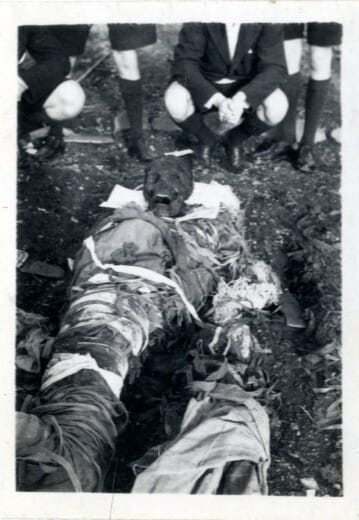
The mummy remained in the School museum until the 1950’s when the library building containing the museum was refurbished, following a substantial donation from Brendan Bracken. The collection was disbursed into several storage areas around the School, including the drama props store. Several pupils ‘discovered’ the mummy in the props stores and wrongly believed it to be a replica, created for a school play. In later life one of the boys wrote a vivid description of the finding of the mummy and the events that took place afterwards. The boys removed the mummy from its display case and tried to lift off the ceremonial head mask. The mask was stuck tight so several boys pulled together until there was a loud ripping sound and the head mask lifted off the body. As the head mask was lifted free a blackened skull inside with shiny white teeth fell forwards on to the face of one of the boys! Sadly, ripping the head mask off had broken the seal of bandages around the mummy and it began to deteriorate, and rapidly to smell very bad indeed. The original bandages, arranged in an interwoven diamond pattern, began to come loose so the boys took it upon themselves to re-wrap the mummy. They visited the School sanatorium and requested a supply of modern bandages from the nurse who was happy to oblige. Despite their best efforts to re-bandage the mummy it continued to deteriorate and so the Headmaster at the time, J. H. Bruce-Lockhart made the unfortunate decision to dispose of the mummy by burning it. This is one of the more shameful moments in Sedbergh’s history.
In ancient Egyptian culture the body was believed to be the vessel that carries the soul to the afterlife. In burning a person’s body, the instigator would be preventing that person from reaching the afterlife. This was a heinous crime in ancient Egypt.
Following the instruction of the Headmaster, the art master and a group of boys in Upper Sixth, created a funeral pyre in the garden below the School Library, now a public car park. The gilt head mask was kept and returned to the School museum, but the body of the mummy was destroyed. This is a most sad episode in the School’s history. It is a great privilege for historians to look after items of cultural significance. But that privilege comes with a responsibility both to preserve items for the future, and to be respectful to the originating culture. Sedbergh School failed on both counts. One of the boys involved wrote in later life that the matter had played on his conscience ever since and that, as a School Prefect, he regretted not questioning the plans of his teacher and Headmaster and asking them to reconsider.
The gilt head mask has long since disappeared from the archive collection, but the photographs of the burning, and the poetry and songs written for the mummy still remain and are treasured.