
History of Sedbergh School in 50 Objects #25: Memorial Cloisters


‘As the British front moves forward our list of casualties grows almost daily: the war takes from us those whom we feel we cannot replace, whose steadfast loyalty to Sedbergh we had counted on for coming years.’ – Sedberghian Magazine, June 1917
Shortly after these lines were penned, the Headmaster and senior staff wrote an open letter to Old Sedberghians seeking to raise funds for a lasting war memorial. The Old Sedberghian Club were tasked with commissioning the memorial and it was hoped that the £20,000 total aimed for would allow funds to assist the sons of Sedberghian casualties. This figure is worth over £1.3 million in today’s money. To say that the campaign was successful is an understatement. The intended total was quickly surpassed, the cause being one that many in our community felt most keenly. The surplus created a lasting fund, the Old Sedberghian Trust Fund, to support the sons of Old Sedberghian’s killed or wound in the first, and later the second world war. Many of Sedbergh’s early and mid 20th century scholars were recipients of this fund.
The memorial Cloisters were designed by Old Sedberghian, J. Hubert Worthington (L 1900 – 05) who trained at the Royal College of Art. An architect of renown who was subsequently knighted for services to architecture, Worthington designed the Memorial for the British Cemetery at El Alamein which resembles the Cloisters at Sedbergh.
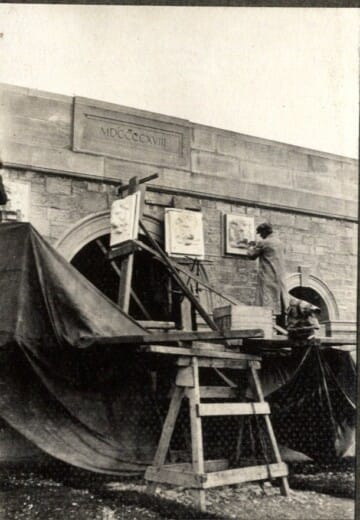
The design was simple, described in 1924 as ‘elemental’, with little ornamentation. The five central arches symbolize the houses which existed at the outbreak of war. Sedbergh’s sixth house, Powell, opened in 1916 but had no WW1 losses. The frontage includes the coats of arms of Roger Lupton and Edward VI below the inscription ‘Their name liveth for evermore’.
The Cloisters were built by Old Sedberghian, E. Harold Pattinson (E 1906 – 08) and his firm of builders. The work of excavating the hillside was considerable as much soil was moved to create a cavity for the Cloisters to sit within, giving the appearance of the Cloisters buttressing the hillside below main school. A light railway was built to move soil away and transport stone up to the site. The stone was quarried locally at Barnard Castle.
Although fundraising began in 1917 it was not until 1922 that the foundation stone was laid. Services of dedication took place on 6th July 1924 in the Chapel, the Cloisters and in Powell Hall. Pupils gave up their usual seats in chapel to accommodate the families of casualties remembered on the Cloisters. Lieutenant-General Sir Charles Harington unveiled the Cloisters and Archbishop Lowther Clarke, an Old Sedberghian, dedicated them.
The mark the dedication of the Cloisters, the following poem was published:
We hope the souls of Sedbergh’s lovers come
Revisiting the School that was their home,
To see if all is well
On river, field and fell,
If all they loved and tended
Is still by us befriended.
In loving memory and with hopeful heart
A quiet Cloister we have built apart,
That haply here they will
Both morn and evening fill
The spot, which consecrate
To them we dedicate.
So tax us not that lavishly we’ve made
This tribute to the sacrifice they paid.
They died in manhood’s prime
Unselfish and sublime.
Should we who live forget
The Dead? Not yet, not yet.
Anon. Printed in the Sedbergh School War Memorial Supplement 1924.
The Cloisters have been renovated several times since their initial dedication. One of the challenges facing the School’s conservation team is finding a balance between the need to ensure that this monument is a dignified memorial to those who gave their lives, whilst also ensuring that the integrity of the grade II* listed structure is preserved for the future. The Cloisters is made from a porous limestone, and is positioned on a Cumbrian hillside exposed to the prevailing wind. Over time the monument has weathered, discoloured and accumulated lichen. The process of cleaning blasts away tiny amounts of the stone, as well as the lichen and other residue, meaning that each occasion of cleaning removes a little of the original structure. A long term solution is still to be found to preserve this most important structure, and with it the memory of the boys who served their country but did not return home.