





Month: December 2022
It is not quite the usual December fixtures for Sedbergh School 1st XV, as they are getting ready to head to the inaugural World Schools Festival in Thailand, where they will be taking on 7 of the biggest school’s rugby teams in the world.
Sedbergh will join Millfield, Trinity and Cardiff & Vale as the four UK teams, with St Michaels (Ireland), Hamilton Boys (New Zealand) and Grey College (South Africa) being the other named participants in the tournament.
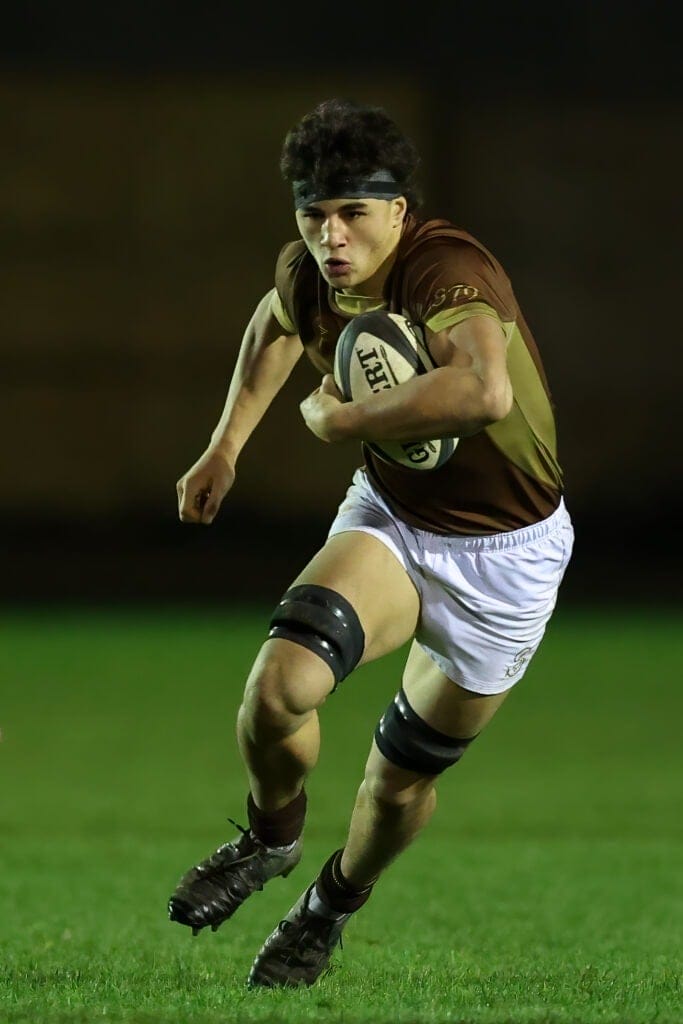
One of the most eagerly awaited new schools rugby tournaments will be held for the first time at Pattana Sports Resort in Thailand between 12th – 17th December. The Festival promises to embody the true spirit of rugby, promoting the traditional values of the sport by gathering some of the most promising schoolboy talent the game has to offer, with plans in place to promote rugby in Thailand as well.
Simon Mulholland, Director of Rugby at Sedbergh School said:
“This is a fantastic new event for schools to showcase the very best of school rugby. We are incredibly proud and excited to be part of such a great line-up of schools from around the world.
It’s going to be a truly unique week for everyone. The tournament is ground-breaking, and as a rugby experience it will give our players lifelong memories of representing the School.”

Mr Newman has been touching on some of Casterton School’s history in his weekly newsletter, which we have reproduced below, as we look towards celebrating its 200th anniversary in 2023.
The School was first established by The Reverend William Carus-Wilson, a member of a wealthy landed family from Westmorland and parish priest at Tunstall. Carus-Wilson had an established interest in education. A prolific writer, particularly on the subject of religious education, he created many publications aimed at supporting children in their exploration of Christian faith. He felt strongly that educational opportunities for girls lagged far behind those for boys and his first foray into education was in fact the creation of a ‘servants’ school’ in 1820, based initially at Tunstall Rectory. Later the school adapted to include a training school for teachers; pupils were charged five shillings a week.
Education for girls at this time was sparse and inconsistent. As the parish priest at Tunstall, Rev Carus-Wilson explored how education could be provide for clergy daughters and began canvassing support amongst his peers. His objective for the school was, “the intellectual and religious improvement of the pupils, and to give that plain and useful education which may fit them to return with respectability to their own homes, or to maintain themselves in the different stations to which Providence should call them.”
First and foremost, he had to find a suitable venue that could be used for both education and boarding. A small terrace of cottages at Cowan Bridge were identified, where Carus-Wilson hoped to accommodate and educate 60 girls. The cottages cost £2,333 to purchase and refurbish, a figure worth over a quarter of a million pounds in today’s money.
On December 4th 1823, he placed a notice in the Leeds Intelligencer outlining the plans for the school and recording the generous donations that had allowed it to be established. Notable amongst the list of Members of Parliament, clergymen and noblemen who gave financial support is politician, philanthropist and evangelical Christian, William Wilberforce.
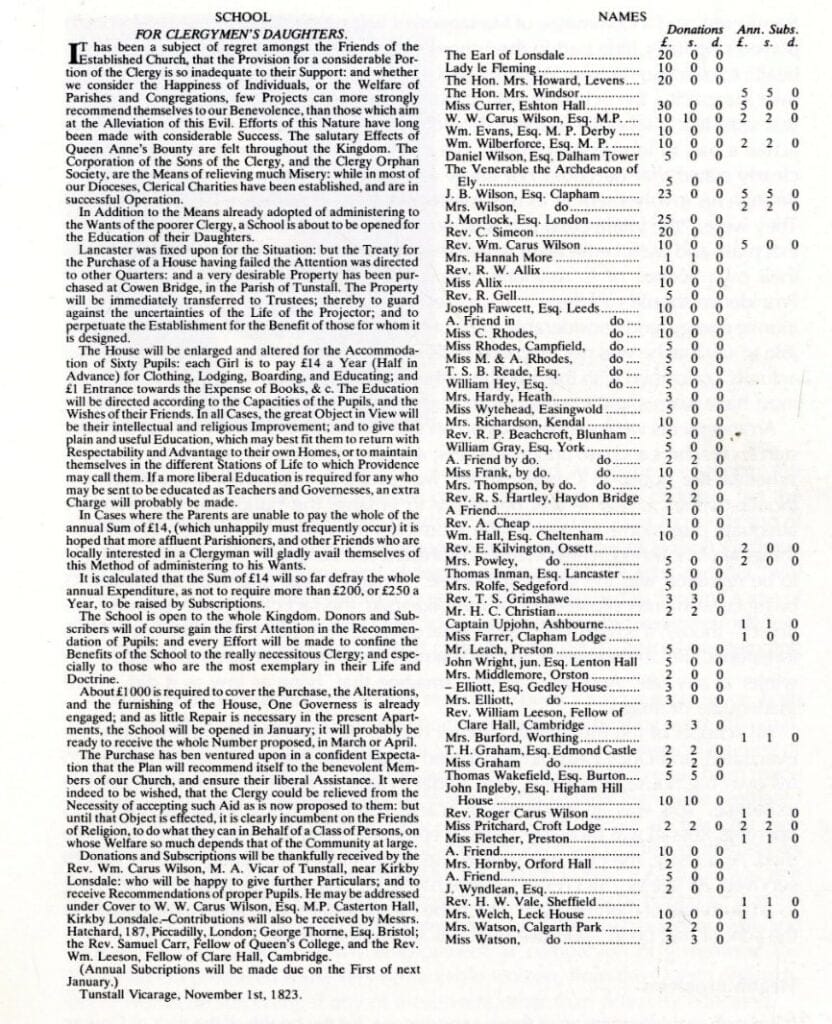
Having been founded in December 1823, the Clergy Daughters’ School at Cowan Bridge opened to pupils the next month with “six teachers and two under-teachers” and grew quickly from 2 pupils to 45 within the first year. The youngest recorded girls were just 4 and the oldest 18 years of age.
In 1824 the Revd Patrick Brontë, who was acquainted with Revd Carus-Wilson, placed his two eldest girls Maria and Elizabeth at the School. It is believed that Charlotte and Emily remained at home initially to convalesce after suffering from whooping cough. Revd Brontë lodged at Cowan Bridge when later that year he eventually enrolled the younger girls as well, so they would have had the opportunity to see the conditions in which the girls lived.
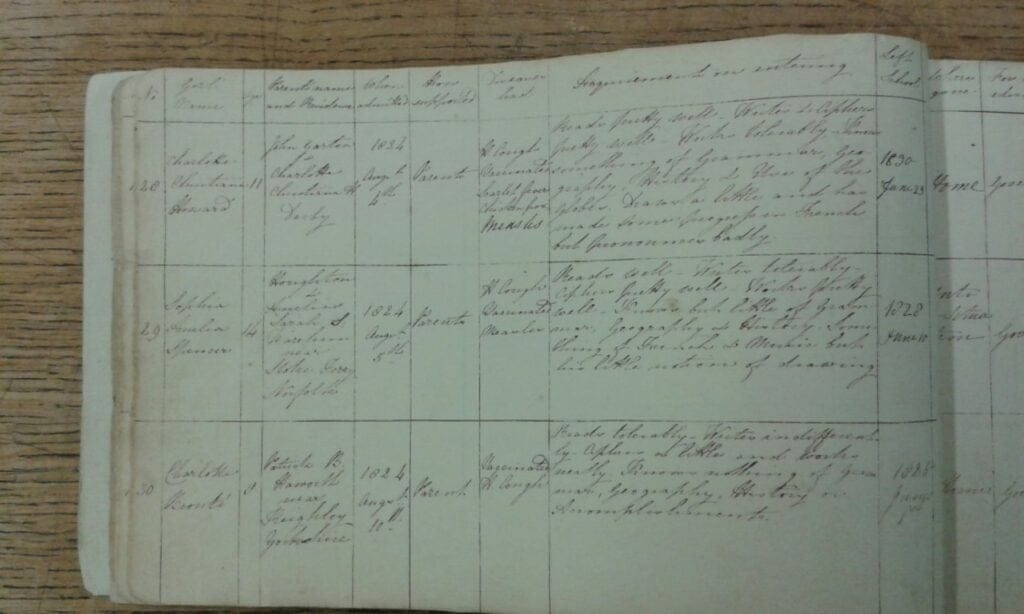
During the winter of 1824 to 1825 the Clergy Daughters’ School was struck by an epidemic. It is unclear which illness took hold; some researchers suggest typhus or perhaps a particularly virulent influenza, others suggest that it could have been lethargic encephalitis. Although no girls died onsite at the School, I am afraid to say that six died at home having been removed due to illness. Maria and Elizabeth Brontë were two of the casualties, dying within a few weeks of each other in the early summer of 1825. Charlotte and Emily were both withdrawn from the school soon afterwards.
Although such news is shocking nowadays, at the time this would not be unusual given the high mortality rates of the time. Indeed, the School roll continued to grow, indicating that the reputation of the school was not damaged by the tragedy. Some researchers have suggested that the Lowood School epidemic depicted in Charlotte Bronte’s Jane Eyre is a semi-autobiographical account of the events Charlotte herself had experienced.
In 1837, Carus-Wilson moved his servant school to Casterton, where it thrived for around a decade. Queen Adelaide was patron of the school and visited in 1840. She did not forget the visit and during the remainder of her life sent for girls from the school to join her attendants, donating £100 per annum in the last twelve years of her life – equating to about £10,000 per year in today’s money. The servants school sadly declined and in 1921 merged with the Clergy Daughters’ School, soon to become known as Casterton School.
The commemoration of 200 years of education at Casterton School will include a Founder’s Weekend and Gala Ball over the weekend of 24th and 25th June 2023. Tickets can be bought at this link and we look forward to celebrating this milestone at this event and over the coming months.
With the 2023 domestic cricket fixtures released at the end of November, we are delighted to share the news that Lancashire Cricket will be returning to Sedbergh in summer to play three 50 over games.
We’re delighted to be hosting Lancashire Thunder for the first time, as we welcome them for two fixtures in July – Friday 7th vs Southern Vipers and Wednesday 19th vs The Blaze – as part of the Rachel Heyhoe Flint Trophy.
The third and final fixture sees Lancashire Cricket get their One-Day Cup campaign underway against Essex Eagles, on Tuesday 01 August.
Sedbergh School Headmaster, Mr Harrison, has said: “We are delighted here at Sedbergh School with our continued partnership with Lancashire County Cricket Club. These fixtures are brilliant for the School and for the local community and we look forward to seeing some excellent cricket being played.”
Director of Cricket Performance Mark Chilton said: “I must thank all three of our outgrounds which we will use next year across both men’s and women’s cricket – we look forward to taking the game to Blackpool, Southport and Sedbergh which always seem to serve up superb spectacles in front of passionate and knowledgeable cricket crowds.”