

Month: April 2023
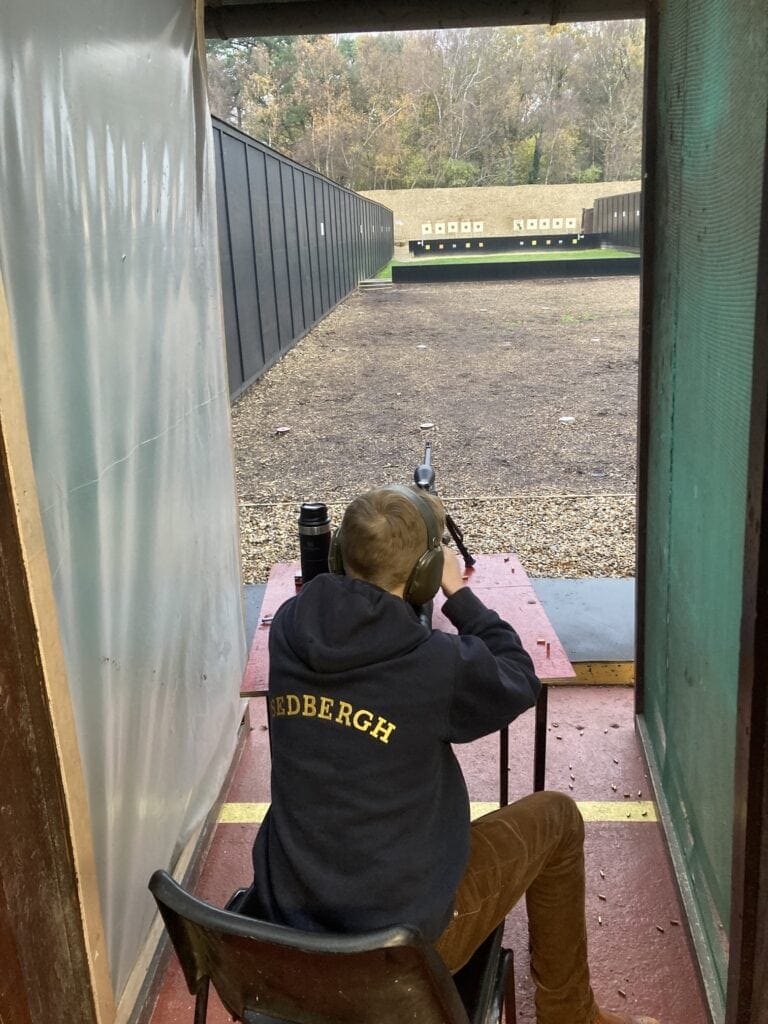
Few people know that Sedbergh School is one of the best target sport schools in the UK. The School has been competing for The Ashburton Shield, arguably the most prestigious prize for school shooting in the UK, since 1905 and have won the Shield on 5 occasions. In 2022, against 29 other schools (pre-pandemic 50+ teams competed), Sedbergh finished second. Most recently, Sedbergh pupils were chosen to join two national teams; the GB U18 Athelings and the UKCRT (UK Cadet Rifle Team) U17.
You might know of target sports as ‘shooting’ – and of course, it mostly it is. However, possibly in a reaction to the negative perceptions linked to shooting, the sport is branding itself as ‘target sports’ which is a more accurate description of what the sport involves. For starters, it’s only aiming at targets (or clay disks called pigeons) and the sport also includes archery.
At Sedbergh, target sports are played all year round; spring and summer is predominantly when long range outdoor shooting takes place and then from September, the focus shifts to indoor shooting and air rifle shooting. The School has two excellent indoor ranges.
Ian Christy, Head of Target Sports at Sedbergh says, ‘Around the country we go and shoot and there are big red flags flying, warning signs saying danger, danger, do not enter. So, the general public often don’t understand it [target sports].’ It’s necessary, but its off-putting. Plus, target sports also have a language of their own that confuses people. To demonstrate, I like to tell the story of something funny that happened a few years ago. We had a young shooter competing down at Bisley National Shooting Centre and her mother had come down to see how she got on. She said to her mum, ‘I’ve just shot 2-15 over the hill and got a possible’. Her mother said, well never mind we’ll go and get a cup of tea and a piece of cake.’ I explained that what her daughter said was that on one of the longest shoots you can do, on one of the most difficult ranges in the world, she scored the highest possible score a human being can score on that range! She did brilliantly! So, her mum added, ‘We’ll get something fizzy then as well!’ But you know, her poor mum had no concept! I try and put it [the sport] into plain speech, but it’s still confusing.’
Top 5 things you didn’t know about target sports
- Most of target shooting is in the mind; aiming is one of the least important things that we do! It’s all about mindset and we spend hours and hours developing that. I’ve heard it said that shooting is a western martial art – and it is. It’s about controlling the body with the mind.
- Many of the best shooters in the world are older. It depends upon the specific area of the sport, but if we talk about long-range outdoor shooting, or target rifle, most of the top shooters are slightly older. So, whereas in other sports, by the time you’re in your mid-thirties, you’re physically past it and may be carrying an injury, in target shooting, you are likely to be just coming into your own in your mid-thirties up until about your sixties. The oldest competitor in the Rio Olympics a few years ago was a 78 year old lady. It’s truly a sport for life.
- The mindfulness and the focus developed in target sports translates directly to academic performance. Study after study of target sports across the globe has shown that there can be an improvement in grade attainment and focus; particularly if a young person is struggling with their focus. Target sports of any type teaches pupils to focus on one task at a time, complete that task to the best of their ability, and then move on to the next thing. So, it’s about ordering things. You have to be very organised.
- Target sports are one of the few sports where there is little difference in the ability of each gender. Men tend to be able to physically support the weight of a heavy rifle for longer and that’s reflected in competition. However, British and Olympic shooting is now looking at changing the sport so that we find some common ground in the middle. Then we’ll find that there’s hardly any difference in scores between genders. Physical size isn’t a factor in making you a better target shooter.
- During target sports we teach quite complex mathematics. It’s done in a way that they don’t even realise that’s what we’re doing. We teach an awful lot of physics – for example, we talk about co-efficiency of ballistics and how things work and some quite complex parabolic flights – complicated physics concepts. We also teach anatomy and physiology – particularly biomechanics – because it’s vital. There’s also a lot of psychology involved too.


Girls’ cricket is a popular, and growing, sport at Sedbergh. To help our girls develop, Sedbergh is delighted to be working with Arathy Jayapal. A talented cricketer herself, Arathy loves our world-class facilities and is excited to be helping our players improve.
What is the main focus of your role at Sedbergh?
To start with I’m learning the Sedbergh way of coaching, which includes having fun! I was trained in an environment where it [cricket] was way too disciplined, but here it’s more fun. I’m also getting used to the facilities that Sedbergh has; they’re amazing! We didn’t have a quarter of it when I was playing [for the state team in Kerala, India].
Do you have a particular coaching philosophy?
Definitely. I have three key pillars for my coaching, which are:
- Keep it simple
- Give me 100% effort
- Show your passion for the sport
It’s the mindset that we really need to change because often girls don’t have the confidence and the will to win that the boys have in sport. Girls also need to have that champion mindset. So, when I’m coaching I need the mindset to be right. I don’t really mind if they miss a ball or miss a catch, I just need them to put in the effort. If you miss a ball, that’s fine. You just go and retrieve the ball and give it back to the fielder or the bowler or the keeper. We play for the team and that’s really important.
Are you expecting any challenges?
Yes. I mentioned that I was trained in a very disciplined environment where we were not allowed to have fun. It was a tough training environment but it did give me discipline and a fighting mentality – and I want Sedbergh players to have that too. So, while the girls are having fun and playing, which is great, I need there to be a balance. Have fun but still have discipline and passion to play. I really want the girls to enjoy cricket as much as I do.
After completing a Masters Degree in strength and conditioning – you have high-level understanding of how injuries develop. So, with your knowledge, is that something that you try to protect your players from?
Yes. I didn’t know about injury prevention [when playing]. So when I started coaching, one of the things that was in my mind was that I have gone through this [injury] and I don’t want my players to go through this. So, I want them to have fun, but also to be disciplined because it’s not just cricket or the skills that we want – it’s strength and conditioning, it’s diet, sleeping habits, everything is involved to be a better cricketer and a better athlete.
What is your favourite hobby?
I enjoy playing badminton and football; they’re fun and competitive but it’s a great alternative to cricket which I do all the time.
Now a fun question! Do you prefer ice-cream or cake? Vanilla or chocolate?
I’m not a big fan of sweets! I like spicy food. But, if I did have something then I’d choose vanilla.
The School of Athens is a pupil led academic society that challenges Sedbergh Students to present and defend their thoughts in a supportive group of peers. More information is available on our School Societies.
Based on a recent experience seeing a trial in action Jamie felt inspired to discuss the issue of public access to legal trials with the School of Athens. Below is the edited transcript of the discussion led by Jamie.
How much access should the public have to legal trials in the UK?
Long before the murder trial of Dr. John Crippen and his accomplice, Mrs. Ethel Lee Neve, it has been possible for the public to attend trials in the UK at all types of court, civil courts, criminal court’s, appeal courts. However, people have not been able to attend all trials. Once portable cameras were invented, journalists began trying to take photos secretly during trials of public interest, which they would then print in the newspaper. The courts found this disruptive to their work and so in 1925, all recording of trials and the UK was banned.
The judge in each case decides how a hearing is held, including whether and how people can observe it if they think it’s necessary for people for the proper administration of justice. A judge can decide to hold a hearing in private with no observers allowed. You cannot record broadcast or take photos of any hearing no matter how you’re observing it. Some courts stream some or all of their hearings online for people to watch. These include the Supreme Court and some appeal courts, but not the criminal court.
I’m sure a few of you’ll recognize that the USA seems to stream a lot more of their cases than the UK and there is a strong history of celebrity court cases being broadcast on television. There are two ways of looking at this. Are they opening up their judicial system to their public or are they trying to commercialize it? For what reasons might the public want access to [celebrity] court trials? What points could be made to argue for the public having less access? Should we take away the right every UK citizen to attend justice being served? Overall, how much access should the public have? The final aspect that I want to highlight is the actual passing down of the sentence; where people don’t go to the actual trial, but attend any court that is giving a sentence.
I was lucky enough to go for work experience at Newcastle’s high court. I worked with a barrister who specializes in criminal law. I was able to go onto a manslaughter case – actually it was murder, but they were able to bring it [the charge] down. It was a one punch kill. I asked them, am I allowed in to watch the sentencing? The barrister explained that I am and that it is every UK citizen’s, right – and so I did. I went in and it really made me wonder, should this be allowed? Should anyone be able to come and watch someone’s life be absolutely destroyed? I was there, I was watching his family. Some of them were happy for the defendant, it was apparently a good sentence for him. I wouldn’t say it was a good sentence for anyone in general, having that on your record, but it was a good sentence for him. But I also saw the family of the person who he killed and they looked distraught. Should anyone be able to see this family in that position? Should we have a right to see them when they’re so vulnerable?
Discussion and Question Highlights
Higher-level crimes; murder, rape, arson, et cetera. are things that affect society as a whole. But, once we see the perpetrator being sentenced, people feel safe leaving their houses. Maybe not too safe, but safer than they did before. This really does let people see justice being served and it is helpful.
So in the UK you can’t record, but you can attend the trial. So, surely just recording is the same as having your right to be in that trial?
Do you think it should be safe spaces for example for people with a mental illnesses or cases involving children? In the court they really go into these kinds of sickness and I think this is quite private. Do you think these kind of cases should be offered to the public to watch?
Should we take away the right of a UK citizen to be able to see justice being served? I mean if you ask me, it goes back to like the Machiavellian times when people would be whipped and tortured in the street. It’s a way of showing justice being served. It’s also kind of a scare factor. You see them walking in with their bag. They know they’re going to jail. They know they’re not leaving that courtroom and going back to their family house, they’re going straight into a holding cell then to a police van and then to jail.
In the case of celebrity trials, there was the recent case with Johnny Depp and Amber Heard. This was a serious trial of domestic abuse. Obviously Johnny Depp has a bigger fan base and so the majority of people were on his side. Who was right and who was wrong? It’s not our choice to say and to decide. He won and maybe he was right, but still, in the end she [Amber Heard] was trying to say something. The publicity that was created was a toxic and also a very dangerous thing. Now she can never go out without getting massive hate. The hate on the internet that was displayed against this woman was not normal.
It’s always a pleasure to celebrate pupils who are excelling in their academic study.
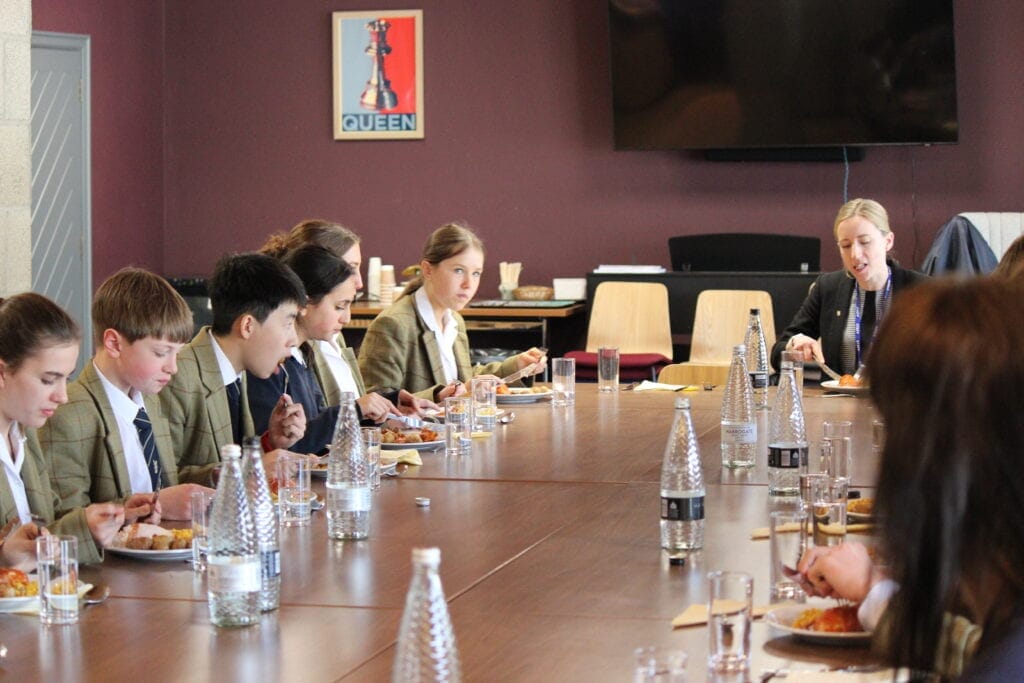
Every half-term Headmaster Dan Harrison invites the top 5 academic performers from years 9 to 11 to a celebratory, Commendation Lunch in Queen’s Hall.
To keep pupils on their toes, during lunch we pose questions relating to recent events. One of the trickiest questions today was about the guest list for the coronation – should this event be about family first for the Royal Family – or should the coronation be first and foremost a state event? After that challenging question we asked what dish our commended pupils would choose as the official ‘Coronation Dish’? Top answers were scones (with jam and cream) and fish and chips!
The questions we discussed over lunch ranged widely! Discussion was animated and opinions were divided on most questions – highlights are below.
Q. If summer holiday is the best, and you could go anywhere, where would you go?
It was pretty much unanimous… hiking in the Atlas Mountains is too much walking!
Q. Pupils were asked about careers they’re interested in that will probably be highly influenced by technology.
Pupils were excited by careers including photography and surgery; interesting choices that are already seeing incredible input from new technologies.
Q. The recent protests at the Grand National horse race delayed the start of the race by 15 minutes. After the start of the race a horse fell at the first hurdle and was euthanized. An angry horse trainer has said that the horses were nervous because of the delayed start. Pupils were asked to consider whether the protesters were right to protest in the way that they did? Could they have protested in a different way?
This was the most emotive discussion question and pupils displayed an impressive understanding of all sides of the situation.
Q. In the context of whether Prince Harry and Meghan should be invited to the coronation, should the coronation be about family first for the Royal Family – or should the coronation be first and foremost a state event?
The table was split down the middle (literally!) for those for and against Harry and Meghan being invited, but everyone agreed that the coronation is a state event.