





Month: February 2024
This presentation was part of our 2024 Pathways Programme. Access additional resources and Old Sedberghian professional profiles at the Old Sedberghian Club, OS Connect.
From securing valuable work experience to choosing the right A-levels and university courses, there are numerous factors to consider when pupils think about a future in law. Old Sedberghian William Kinread kindly spoke to Sedbergh’s aspiring young lawyers to answer common questions and offer valuable insights to help pupils make informed decisions. William is now an in-house lawyer, with broad experience working with private clients and instructing lawyers internationally. During his engaging discussion he talked about the value of work experience, selecting A-level subjects, and the advantages of different university pathways.
You really need to do work experience…
One of the first things I think we ought to talk about is work experience because you really need go and get some work experience to see what it’s like being a lawyer. However, work experience is getting harder and harder to arrange for 16 – 17-year-old pupils. One of the reasons for that is that you are really asking for a favour and secondly it’s harder and harder for employers to accept people for work experience because the School needs to see a health and safety policy, employer’s liability insurance, all these sort of things.
However, you can get past it and your CV and extra-curricular activities are important. Recently, we received an application from a young girl and her CV was so outstanding that my colleagues and I decided that we can’t not give her work experience. The outstanding thing about it, more than her excellent GCSE results, was that she does charity work in her spare time, she’s also excellent at sports and excellent at music. She’s really a well-rounded person with lots of interests and I think that it’s important to show that.
Be conscious of what you post on your social media
I want you to be aware that when you go for interviews and so on, people will look your Facebook (Instagram, TikTok etc) and they’ll see what’s on there. So just be aware that your social media is going to be looked at. Your social media is a sort of unofficial CV; you’ve put things on there like contacts and events – things that people will have a quick look at to see what does this person do? So it is just important to bear that in mind.
What A Levels should you do?
You can do any A levels to be a lawyer. There are no A level requirements. So, I recommend that you do what you enjoy because if you do what you enjoy and what you are interested in, then you’ll get better results – and good results are what’s important. If you want to do Math, Physics and Chemistry or English, History and Geography or Biology, English and Music, do that. What’s important is that you get the results. However, be aware that you might need to do subjects that go together because not all subject combinations can be scheduled in the School’s Curriculum.
No particular A levels really help you in law. You need to be literate because you have to write lots, so it’s good to be good at English, but you don’t have to have done English A level. Similarly, it’s good to know a bit about history, but I didn’t do history – I just read a lot of history. I know people that are scientists that have then done law at university.
The only thing I think you shouldn’t do is a law A level because it’s a huge subject and you’re just doing ‘law in a nutshell’ – and you’ll have to relearn the whole thing again from scratch at university anyway. So it’s a waste.
What should I study at university? Should I do the conversion course?
I’m assuming you are all planning to go to university and then law school and all that sort of thing. Nowadays there are other options. For example, you can go to solicitors firms and do five years work experience. I have no experience with that although you can look it up; visit https://www.sra.org.uk/become-solicitor/admission/pathways-qualification/ and it will tell you all the requirements to become a solicitor and all the different routes.
If you are going to university, your choice is either to do law or do a different degree and then a conversion course. My opinion is that if you are uncertain about law, but you love – let’s say English – then do an English degree. It gives you three years to sort of think things through and you can do a law conversion if you do decide to go into law. What you’ll end up doing is making it a year longer before you qualify as a solicitor. I can remember being 18 and thinking, oh, six years to qualify. I can’t believe it’s so long. It goes like that. If you do a different degree first, followed by a law conversion, it’ll be seven years, but it’ll go like that. So, if you’ve got a love for a different subject and you’re not a hundred percent sure about the law, then it’s fine if you do the conversion course and then the part two exams.
With the conversion course you haven’t had quite the same foundation as if you did a law degree because in one year you’re learning a lot of what other students have taken three years to do. It’s more factual based than university law; university is a bit more academic and you’ll look at questions like, ‘Do judges make law?’ If you do the conversion course, there’s no time for that sort of thing. So, that’s the difference. Another example of that is that in the conversion course you don’t spend much time on the concept of joint property; you’ll learn in half an hour what we spent a month on at university. Sometimes you can then be practicing law and you just feel a slight disadvantage, but you can always go back to basics, as needed, yourself. So, that’s my viewpoint, however, conversely, I know an agricultural lawyer that did agriculture at university and then did a conversion course and he believes it’s the best thing to do. I’m sure he would say, don’t do law, go and do something else because he understands all about farming. There’s so much flexibility, so many options nowadays, I think if you’re not sure about being a lawyer, don’t saddle yourself with things too early.
Which university should I go to?
The best one; get the best grades you can and go to the best university you can. The only thing is you do need to look at the precise degrees that are on offer because at Oxford for instance, it’s not a law degree. It’s jurisprudence, or it was – which is more like the philosophy of law. Nottingham, for instance, was renowned for being really good at law. So it’s worth having a look around. I went to Leeds, which again, is good at law.
Should I be a barrister?
In the old days, barristers were the only ones that had rights in the higher courts. So, that’s why all the court case cases and films have barristers. Nowadays, solicitors have that audience as well. And barristers are used for other court cases, but solicitors could do it themselves. Now it’s a big firm. They have advocates there and legal opinions, but solicitors can do that as well. One day, in the not too distant future, the professions may merge like they have in America, and we’ll all just be lawyers.
When I was your age and I decided I wanted to be a lawyer, I wanted to be a barrister. You don’t need to decide solicitor or barrister until you get to university; you’ll do the same law degree whether you want to be a solicitor or barrister, but one year in, you need to make that decision. It’s not actually as hard academically. Barristers have a chamber, they’re a member of chambers and they work on their own. Solicitors are in a partnership. Barristers tend to do criminal law to start with and then hope that they build a reputation to maybe move on to commercial things. There are 10 times as many solicitors as barristers; there’s about 17,000 barristers in the country and 170,000 solicitors. Of the 17,000 barristers, probably 16,750 are earning minimum wage or not much more. It’s horrific. They’re all going on the strike because there’s no legal aid anymore except for really serious cases. They are paid by the government, and the government don’t want the cost of legal aid, whereas solicitors are paid by clients. So, it’s a really hard career path and it’s often very poorly paid.
If you absolutely have your heart set on it, then do it and be as good as you can, but you should go and get some work experience to see what it’s really like.
Why do your personal values matter?
Solicitors look after client money. Compare that to my accountant; he never gets any of my money – he does my work, sends me a bill at the end of the year and we pay him. However, if I’m buying a house, I sent my solicitor the money for the house and then a few days later he buys it. If you have a dishonest solicitor, the clients are at risk. Because of that, the solicitor’s profession is very highly regulated. So they’re going to check that you’ve been honest, you haven’t got a criminal record, etcetera, etcetera.
Do lawyers specialise?
Just like doctors specialise, lawyers also specialise. There is no sort of general practicing lawyers anymore; they all specialise in one subject really. All those subjects lead to different types of career, different types of firm and different ways of life. You don’t have to think about it now, but you’ll be thinking about this at university.
The firm I work with, when we act internationally, we instruct a firm of international lawyers. They have fantastic offices in Brussels and they charge £650 an hour. They work in teams, so when I instruct them, I don’t have one lawyer acting for me, I have a whole team and the bills are eye-watering. It’s very exciting work, but they require a lot from you. In Ireland, we use a different firm and in England we use a tier two firm, so £350 an hour. We only need a two-tier firm because we’ve got me. My career, when I was practicing law rather than being an in-house lawyer, I was doing private client work which is different again. That’s acting for people like your parents and has very different requirements in terms of working hours and culture.
Then there are niche firms that we use for different things, like when we register patents and trademarks and we use a firm in Birmingham. They’re really small, but all they do are these trademarks and patents. If you’ve got a real interest in that, that’s a way of being in a small and cozy firm but still able to make a living. That’s the difference between the guys in firms that make a million a year, and those in a small village where you will probably do a few wills and a bit of property work. It will be a very different way of life, a different income, different demands on you. You need to look at the sort of culture that all these different firms have, look at their websites and so on and thinking about what suits you.
Then there’s in-house lawyers like I am. In-house, lawyers are judged on a very different set of criteria to commercial lawyers.
Is a law degree helpful if you don’t become a lawyer?
You don’t have to be a lawyer if you’ve done a law degree. You need to make that decision at the end of university rather than going on and doing the law exams. It’s a good general degree, but it is a general degree. It’s not a specific degree like engineering. It’s not vocational for anything other than law. A lot of people say do law, it’s a good degree, but if you’re not going to be a lawyer, it doesn’t automatically lead to anything else.
Conclusion
In conclusion, embarking on a legal career entails careful consideration of various factors, from gaining work experience to selecting A-levels and university courses. While the path to becoming a solicitor or barrister offers flexibility, it demands dedication and awareness of the evolving legal landscape. Ultimately, personal values, interests, and long-term goals should guide your journey into the legal profession.
After a stellar performance in January 2024 to come 13th in her first European biathlon race against competitors from Austria, Switzerland, and the Czech Republic, Elif (Year 11, Robertson) was chosen to represent GB in the Youth and Junior World Championships in Otepää, Estonia in February (23 Feb – 2 March 2024). This is a big step up for Elif who hopes that this experience will help her if she is looking to compete in bigger international races and possibly the Olympics in a few years.
During term-time Elif has a challenging timetable of training, gym, running, roller skiing and shooting that she manages in addition to her school work. Elif’s House Mistress is instrumental in helping her to manage her GCSE studies whilst training; Elif’s subject teachers help by ensuring she has support and materials to complete work when she is travelling. After GCSE, Elif plans to study A levels in Chemistry, Psychology, Geography and an AS in French. Following a gap year during which she plans to focus on her biathlon career, Elif hopes to study law whilst continuing to compete.
What does a biathlon race look like?
There are various different types of races. There’s a pursuit where you start off in 30 second increments and you’re chasing the person in front of you, a mass start where you all go at the same time, and a sprint which is a fast race. Races are a round loop of (usually) 2.5k – so you’ll do a loop then you’ll shoot prone (which is lying down) and if you miss any you have to do a penalty lap (about 100m) per miss. Then you go again and next time you do a stand-shoot. In a pursuit you may have 4 rounds with 4 shoots; a prone then stand, then a prone and then a stand again.
It varies in each race but you’ll do some type of loop, a shoot, loop, shoot… again and again.
How nervous do you get when you compete?
On the start line its so nerve-wracking! Especially if there are lots of people watching you. But I find that being nervous helps drive me. Once the starting gun or whistle goes all of my nerves disappear and I just focus on my skiing and get going.
Where would you like your biathlon to take you?
If I continue as an athlete I could go to bigger and bigger races, I could get sponsors and ultimately I could go to the Olympics. After a couple of years I could go into coaching like some of the older athletes in my team. I haven’t really thought of it but it could be quite interesting to use my law degree to go into helping athletes.
Biathlon is comprised of two very different sports. Being at Sedbergh you’ve got great access to shooting practise, but how do you practise skiing?
In the UK we obviously don’t have much snow so we do roller-skiing! If someone driving past saw us they’d definitely give us funny looks! It’s really shorter skis on wheels and we go to a bicycle path to do it every Thursday. Other than that – there’s not much that we can do except keep up our cardio and work on our strength. When we are away we focus on our technique and if we go in with good strength and endurance then we can pick it up quickly.
What’s your biggest challenge in biathlon?
Because I’m newer to the sport I’m always worried that I’m going to be the least prepared. Most of the other people – especially in the Scandinavian countries – they’ve been doing the sport since they could walk. They get on skis really young. So, my biggest challenge is catching up to them. But I think that with hard work and really focusing on it, I can get there.
How involved are your parents?
They’ve been so supportive of me; they fly out with me to watch my races and they’ve encouraged me to carry on. When there’s a race that maybe hasn’t gone the way I wanted they always tell me its OK and that they’re proud of me. That keeps me going. I always want to make them proud because they’ve supported me all the way.
You are a great scholar and you are pursuing challenging academic goals; how do you manage your study?
Before going away I message all of my teachers to ask them to set me work and send me information I’ll need. I also travel with all of my books – which takes up quite a lot of space! Every day during training we tend to have quite long rest periods – because rest is really important when you’re training so much – so, while I still take time to relax, I’ll just get on with doing some work. My teachers always stress that I can contact them if I need any help; my teachers have been really supportive. It’s definitely difficult keeping on top of it, but it’s not impossible.
Have you needed to make any sacrifices to pursue your biathlon ambitions?
I wouldn’t say there has been much actually. Obviously I’m training quite a lot and so maybe I miss out on some things at School, but I think in the long run my sport is going to give me a lot of opportunities and I know I’ll see my friends when I get back. I think it’s worth it.
I was worried at the start that I’d miss out but my friends message me every day when I’m away and they all said, “you’ve got to do it” – even before they knew what biathlon was! My friends are really supportive and proud and their support has really meant a lot to me.
Sedbergh School and Sedbergh Prep School are incredibly excited to be working alongside The Yoto Carnegies and England’s Book Town, to organise a one-day children’s literary festival this Spring. The schools will be hosting several events on 23rd April for Primary and Secondary children at both the Sedbergh and Casterton sites.
Partnering on this event supports the School’s aim to foster a spirit of adventure in children, both in and outside the classroom. The events planned for the Book Town Takeover are truly inspiring, engaging pupils of all ages to super-charge their creativity through the mediums of reading and illustration.
We are very honoured to be able to welcome former UK Children’s Laureate, Anne Fine to the Prep School as part of this event. Free tickets to this event are available at this site and are limited by capacity of the venue: https://buytickets.at/castertonsedberghpreparatoryschool/1191270
You can read the official press release from our partners below:
The Yoto Carnegies, the UK’s longest running and best loved book awards for children and young people, today announced a partnership with Sedbergh, England’s Book Town, to deliver a free day-long festival of events celebrating outstanding reading experiences for children and young people.
Scheduled for Tuesday 23rd April, the Yoto Carnegies Book Town Takeover is made possible through a partnership with Sedbergh School, Sedbergh Prep School, and Pen&Inc magazine, a champion of diversity and inclusion in children’s literature.
The festival’s daytime programme will cater to school groups, featuring sessions with the 2024 Yoto Carnegies shortlisted illustrators, renowned children’s authors, publishing experts specialising in material for young readers, and experienced group leaders for the Carnegies Shadowing Scheme. This national reading initiative involves groups reading the shortlisted books and voting for their favourites. Additionally, there will be a dedicated session for educators and librarians to explore shadowing as an avenue to foster a love for reading and engage with diverse book collections.
The evening session, set on World Book Night, will be open to the public and will feature a headline appearance by Anne Fine, a two-time recipient of the Carnegie Medal for Writing. Notably, Fine authored ‘Madame Doubtfire,’ later adapted into the blockbuster film starring Robin Williams. Anne Fine was the first novelist to be honoured as the UK Children’s Laureate (2001-2003) and has contributed to various genres, including picture books, chapter books, middle-grade fiction, young adult fiction, and adult novels.
Anne Fine said, “Winning the Carnegie Medal is the highlight of any children’s writer’s career, (may I boast that I’ve done it twice?), and such is this prize’s importance that it’s fitting that this year there’s a partnership between the Yoto Carnegies and Sedbergh, England’s Book Town. I very much look forward to speaking at this day long festival, which will promote books and reading for children and young people.”
To register your interest to attend the Yoto Carnegies Book Town Takeover on 23rd April 2024 in Sedbergh, England’s Book Town, please contact carnegies@sedberghschool.org
The shortlists for the 2024 Yoto Carnegies will be announced at a panel event at London Book Fair beginning at 9.15am on Wednesday 13 March. The winners’ ceremony will be hosted live and streamed online on Thursday 20 June.
Pen&Inc magazine and the Yoto Carnegies are partnered in their mission to create a better, more inclusive world through reading for pleasure, and are both a part of CILIP, the Library and Information Association.
Yoto, the innovative screen-free audio platform for children, proudly headlines the Awards as the main sponsor. The Yoto Carnegies also receive support from ALCS, with Scholastic serving as the official book supplier and First News as the official media partner.
For further information on The Yoto Carnegies 2024 please visit: www.yotocarnegies.co.uk #YotoCarnegies24 | @CarnegieMedals
This presentation was part of our 2024 Pathways Programme. Access additional resources and Old Sedberghian professional profiles at the Old Sedberghian Club, OS Connect.
Tom Hartley (Evans House 88-93) completed A levels in history, geography and economics and went to Northumbria University. While not really certain what he wanted to be, he spent a placement year from University working in London as an accountant. Although he realised pretty quickly that accounting wasn’t a career he wanted to persue, it was during that time that he became curious about working in a mythical place called “The City” and discovered an interest in investments – specifically, the area of private client investment management. After a spell doing work experience he was confident that he’d found what interested him. He joined Brewin Dolphin in May 1999 and is now Divisional Director – Investment Management.
Tom is keen to express how grateful he is for the “enormous amounts of assistance” he has received from Old Sedberghians helping him on his journey; both in terms of when he was thinking about a career in wealth management and then subsequently when he’s met Old Sedberghians as part of his networking, a key aspect of what what he does when developing business opportunities.
I have some clients that have been with the firm for many, many years. So, I know families really well and that’s at the heart of what I do. Essentially my role is to manage private clients individual portfolios and we give really personalised financial advice; growing their money, preparing them for retirement, preserving their lifestyle and passing on wealth to different generations.
If we look back at really the last 25 years since I joined Brewin Dolphin, I would call myself a stockbroker. The information about companies, information about the internal workings of businesses was held by a small group of people in the city. Technology has totally changed that and that information is freely disseminated. There is enormous amount of propriety research which takes place within the city about companies, about the prospects for companies, about how companies are doing, and what’s the best company to buy in certain sectors. People in jobs like mine have morphed from being stockbrokers to investment managers to what we describe now as a wealth manager.
Financial planning is a really interesting area and encompasses really four key areas, retirement planning, trust and estate planning, taxation and protection. We all understand what retirement planning is; that’s putting money aside for your retirement to make sure you have enough income. Trust and estate planning is for people who have generated capital and have significant wealth and they want to pass that down to the next generation in a tax efficient manner. Taxation is again self-explanatory, trying to take advantage of all the legal ways which we can preserve and grow capital in the tax efficient manner. Protection is looking at trying to ensure that when you are younger and you have children that you are protected against critical illness and, sadly, death. So we try and make sure that people have got enough insurance in place that their loved ones are protected in the event of something untoward happening to them.
What I specialise in is discretionary investment management; discretionary meaning where clients essentially devolve the responsibility for the management of their assets to someone like me. That is where I build investment portfolios with a variety of different asset classes. We spend a lot of time trying to understand the needs of our clients. A typical financial journey starts when someone is young – at your age you’re not starting earning yet, but as you start earning, you should start thinking about maybe investment planning; putting aside some money – and I could spend a lot of time advocating the advantages of early money and investing – that’s for another conversation. You can see as people get towards retirement then they’re looking at their earnt income will be probably declining. They’re not working but they’re looking to essentially draw on their planning which has taken place. You can see the key thing there, the word planning is used many times. So we spend a lot of our time talking to clients, understanding their needs, their objectives to be able to put in place something which is a credible plan for their risk tolerance.
What I do is try and build really trusted long-term relationships with clients to understand what they’re really looking for. They may have inherited money, I’ve had a couple of clients who’ve who’ve won the lottery, some have received money from a previous generation, they may have sold a business which they worked through all their life. So this is trying to understand what are their needs, what will they need income for from that investment portfolio, do they want to pass it on, do they want to continue to grow it? Are they actually in their twenties or thirties and wanting to look at that pot of capital growing at a reasonable rate per year to provide them with enough security to retire at a certain point in time? So, that’s really the initial work and then it’s developing that plan and then moving on to developing that investment portfolio, which is really my key area and what I spend my day dealing with. And then it’s constantly reviewing it.
So we come to the crux of investment and the crux of our approach is preserving capital relative to inflation; if you put all your money in cash and it generates a 5% return, but inflation’s running at 10% means that the capital is eroding. It’s a bit of like an ice sculpture melting. You don’t actually see it really, but your money is eroding all the time relative to inflation. You’re probably aware – inflation has been really topical over the last two / three years – for a long period of time since the financial crisis in 2007, inflation’s been running at 2% and suddenly, after covid, there’s been a period of time where it went up to approximately 12%. It’s coming back down now. But inflation has had a profound effect on financial markets and the pricing of all asset classes because interest rates have had to go up quite significantly from the very low rates pre 2022. The effects of that inflation are that a £100 today, if we essentially have 10% inflation, it would be worth seven £7.18 in 25 years. So, at the heart of what we’re trying to do is we’re trying to protect the capital against inflation. What we come onto is investing for the long term.
When I was at university and was thinking about a career in wealth management, I watched films like Wall Street and read Nick Leeson’s book on trading and I got quite captivated by that sort of life. I was thinking, ‘Wow, it’d be quite fun to be on a trading floor’. In films you saw these people shouting and things looked quite exciting actually. What you realize quite quickly is that those who focus on the very short-term tend to actually lose a lot of money. And those who focus on long-term investing are the ones who actually are the silent winners really. If we spend time looking back at history, looking at empirical evidence, it shows that actually long-term investing is the right approach.
There are five or six key asset classes which we use to construct investment portfolios. This gives us essentially six core risk categories, and coming back to that point about developing that relationship with the client – it’s understanding their needs, their aspirations, and also their attitude to risk. We scientifically test that by asking clients to complete questionnaires which gives us a sense of their attitude to risk, and it gives us a sense of a starting point in terms of how would they feel about different risk categories. It probably goes without saying that the higher risk categories, over the last 10 years, have performed a lot better than our lower risk categories, but there’s a lot more volatility.
So the portfolios are moving month-by-month. So just really coming on to what my day to day job is really is that we are spending our time looking at the economic and business cycles and coming back to that number one – protection against inflation. But what we like to do is, we are active in our management of portfolios and you may have read about debates between active investing and passive investing. Passive investing is essentially just buying tracker funds, which just tracks the FTSE100, it tracks the S&P 500, but it tends to just give you market performance. What we are trying to do is outperform benchmarks. So we spend our time looking at different sectors, different companies – building the list. We’re balancing the risk and return and then asset allocation, making decisions whether to buy more in bonds, more in cash, more in equities. And we’re constantly tinkering with our asset allocation to try and generate returns for our clients which beat the market.
There’s very different mandates across my client base, but we are really well supported in terms of research. Now we come to different roles and responsibilities. We’ve got people like myself who are client facing, but we’ve got a huge number of people who spend their time just researching; you’ve probably heard of analysts and strategists? Those are interesting roles. They’re not necessarily client facing, but they tend to provide the likes of me with a huge amount of information. Although no two days are the same, I start the day with a morning call with our research team which will update us on what’s happened over night in markets, the companies which we follow, which have reported, what the numbers are – because we spend our time worrying about what companies are saying to us rather than what the market reaction is. A company might have some really good news, but the share price may be down 5% for a particular reason. We want to know why. So we have a half an hour call which goes to all our offices. Then it’s communicating with clients, talking to clients, but it’s also making changes to portfolios or a client may say, I want money out, I want to buy a new car, how would I raise that capital? So it’s constant dialogue with clients and what comes from that is those really strong trusted relationships you have with individuals.
You’ll be surprised to know that we spend a lot of time worrying and thinking about stewardship and ensuring that because we are one of the biggest private client investment managers in the UK running just over 50 billion, we have a huge responsibility to make sure that we’re acting in a responsible manner. So we vote on behalf of our clients, but we’re also engaging with companies in terms of making sure that we’re helping them formulate their strategy. We take that very seriously. And then coming onto the ESG side, we overlay all of our investment recommendations with an ESG (Environmental, Social and Governance) lens as well to make sure that we are focusing on buying companies which have got an ESG angle to them and they are acting in a manner which we would hope they would be on behalf of all their stakeholders.
I want to talk now about the characteristics which we look for in young investment managers. From our side of things, we have three core values; genuine, expert and ambitious. We look for really genuine people, people who care passionately about their clients, care passionately about making sure that we interpret their investment mandatescorrectly. The expert is knowing your investments, knowing the areas which you can help your clients with. So, I’ve been here nearly 25 years and I’m on that lifelong learning journey, which is so important and something which I think is sometimes forgotten. We’re looking for people with huge ambition. We have ambition for our clients but also ambitions for oneself and the business. So, I would sum up by saying if you’re genuinely interested in people and curious about world affairs, companies and markets, it’s a great career.
In terms of qualifications, I think it’s a little bit different now, for me I went on a three year journey to develop and gain my professional qualifications. In terms of career progression, I look back on my time and I always think actually I was quite patient – that’s important, actually learning to put what you’ve learned into practice – you have to learn markets, you have to go through experiences which are quite challenging. It’s not very nice to say you bought a stock and it’s down 50% and you have to explain why, but that actually part of the learning curve and that’s really important as you go forward in your career. Some of the younger generation are very keen to progress and manage more and more money, but actually we realize that it’s really important to go through that cycle.
Conclusion
Looking back at the past 25 years since joining Brewin Dolphin, the transformation in the financial industry has been remarkable. With technology revolutionising information dissemination, roles have evolved from stockbrokers to investment managers to wealth managers. Financial planning encompasses crucial areas like retirement planning, trust and estate planning, taxation, and protection, all aimed at securing one’s financial future. My specialisation lies in discretionary investment management, where understanding clients’ needs is paramount. We craft investment portfolios tailored to their risk tolerance and long-term goals, actively managing assets to beat the market. Stewardship and ESG considerations are integral to our investment philosophy, ensuring responsible and sustainable practices. For aspiring investment managers, qualities like genuineness, expertise, and ambition are vital, coupled with a commitment to continuous learning. Qualifications such as the Securities Institute diploma in investment management lay the foundation for a rewarding career.
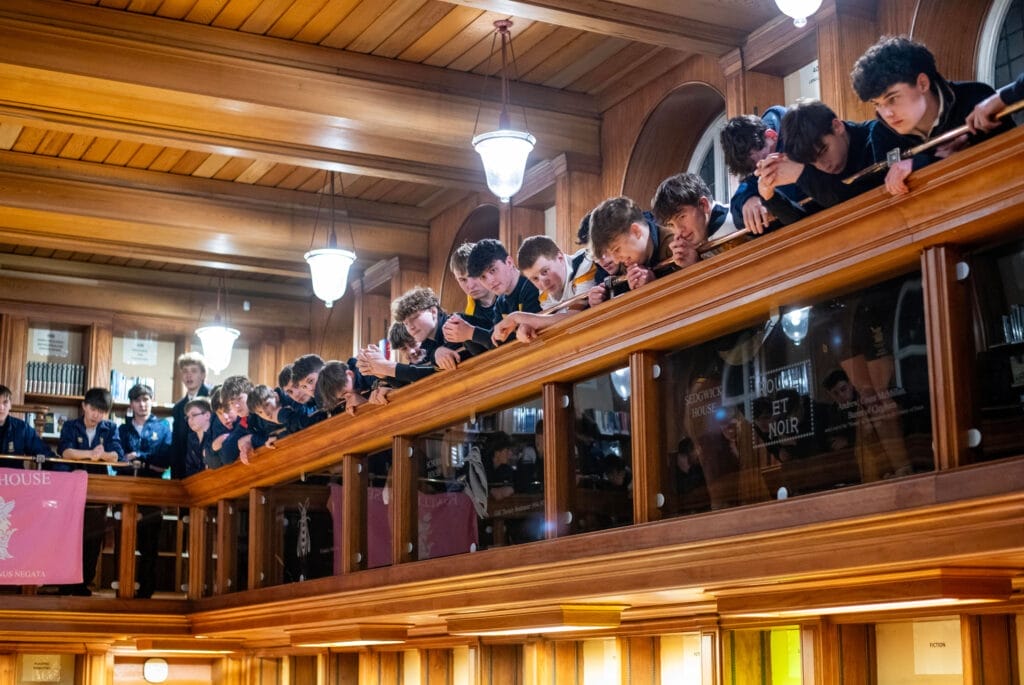
The annual Academic Challenge is a hard fought event between teams from each of the houses.
Last night the Academic Challenge came down to an epic final between School House and Sedgwick. Tied at 230/230, the final sudden-death, tie-breaker question ‘Which Hindu goddess is worshipped as the destroyer?’‘ was answered correctly – with awe-inspiring calm – by Sam from Sedgwick House. It is ‘Kali’, not ‘Shiva’ which was the answer given by School House. Following is a selection of other brain-stumping questions faced by the finalists:
- Name one of the two US states which has given its name to a chemical element.
- In the 18th and 19th centuries, what were taken by resurrectionists?
- What is the second prime number after 53?
- Which novel by Aldous Huxley is set in the seventh century After Ford?
In a moment that will surely go down in history, one of the Sedgwick team was so overcome by the team’s triumph that he fell off his chair.
Special thanks for the event go to Mr Lewis who delivered the questions, Mr Davies for scoring and to all houses and participants for their participation and support. A special thank you to the spectators whose behaviour was impeccable in every match.
It must have been tough for School House to lose having been so dominant all tournament. Credit to School House, they were outstanding. I am absolutely thrilled and extremely proud that we won the Academic Challenge Shield. I am particularly pleased for the boys. Whilst we have been very consistent – in my ten years [as Sedgwick Housemaaster] we have made the semi-finals of the Shield nine times in the last ten years and the time we didn’t win, we won the plate – we have actually only won the competition three times previously. William has been in the team for five years and Tom and Sam for four years. All these boys are now in the upper sixth so it was absolutely their time to finally win! I hope the younger boys coming through the House can continue the high standards within this fine competition for years to come.
The late Micheal Raw, who ran this competition for years, was a dear friend of mine and I am delighted we won the Trophy in my last year within Sedgwick House. Michael would have been looking down and he certainly would be delighted by the standard of competition this year.
Stuart Oliver, Sedgwick Housemaster


In response to the demands of a rapidly evolving and unpredictable future, Sedbergh School is proud to unveil an ambitious and groundbreaking Year 9 curriculum named 9 INSPIRE. Designed to meet the challenges of our dynamic society, 9 INSPIRE goes beyond traditional subject titles, fostering a blend of skill and topic-based learning to equip pupils with the essential tools for success.
Mrs Abby Stubbs, Deputy Head Academic at Sedbergh School, expressed her excitement about the INSPIRE initiative, saying, “At Sedbergh, we believe in preparing our pupils not just for academic excellence but for life beyond the classroom. 9 INSPIRE is a testament to our commitment to instil confidence, passion for learning, and crucial life skills in our pupils.”
The 9 INSPIRE curriculum focuses on cultivating indispensable skills such as teamwork, project management, and problem-solving. It integrates Sedbergh’s core values of humility, ambition, resilience, and kindness into every subject, emphasising the importance of personal success and happiness.
VISIT the 9 INSPIRE home page.
Key benefits of the 9 INSPIRE Curriculum include:
- Values-Driven Learning: Core values are seamlessly woven into every subject and form the basis of termly schemes of work.
- Collaborative Learning: Utilises collaborative learning approaches to encourage teamwork and interpersonal skills.
- Real-World Skills: Focuses on developing practical, real-world skills and competencies essential for success.
- IT Skills Integration: Seamlessly incorporates IT skills into various facets of the curriculum, ensuring technological literacy.
- Blue Sky Thinking: Encourages innovative thinking and problem-solving, preparing pupils for the challenges of the future.
- Global Issues Exploration: ‘Inspire’ days expose pupils to global issues, fostering an understanding of their role in positive change.
- Project Ambition: Promotes an ambitious approach to tasks, introducing blue sky thinking and creative approaches to project work.
- Route to Resilience: Involves challenging projects in creative arts and sports to develop resilience and competency.
- Sedbergh Gives Back: Encourages pupils to work on projects that contribute to societal issues, promoting empathy and kindness.
The INSPIRE curriculum leverages cutting-edge facilities, collaborative spaces, and the integration of Xello, a careers-based platform. The comprehensive use of technology ensures that pupils are not only prepared for their academic journey but are also inspired to think innovatively about their future paths.
9 INSPIRE is a springboard to GCSE
Year 9 at Sedbergh serves as a crucial juncture in the progression of pupils from prep to senior school. Beyond academics, the curriculum provides opportunities for social growth, new friendships, and the exploration of individual strengths, acting as a springboard for the impending GCSE phase.
Mr Dan Harrison, Headmaster at Sedbergh School, stated, “Year 9 is a pivotal stage in a pupil’s journey, and this new programme is crafted to provide them with a holistic set of values and skills and keep them younger for longer. We want our pupils not only to excel academically but also to become positive forces in society, contributing meaningfully to the well-being of others. At Sedbergh we are very fortunate to be located in one of the most beautiful areas in the UK, enabling us to take lessons outside and give our pupils the opportunity to discover hidden talents in a safe, familial, full boarding environment.”
The 9 INSPIRE curriculum is appropriate to pupils coming to Sedbergh from any traditional Year 8 course. As with learning across all years at Sedbergh, it includes opportunities to challenge and extend our most talented pupils, ensures pupils achieve required learning targets and will access the early stages of our Pathways programme.
After joining Sedbergh in Year 10, Jemima discovered a passion for classics. She is now studying for A-levels in French, History, and then Classical Civilisations. She also completed an extremely topical EPQ on whether we should return historical artifacts to their native countries out of museums. Whilst not sure exactly what pathway she’d like to pursue after university, Jemima has an eye on “maybe something in government; I wouldn’t mind the foreign office – that has always really interested me.”
Jemima has received outstanding offers – including to study at the University of Oxford. Her second choice was a decision between the University of Exeter or Royal Holloway, but she has decided to go with Royal Holloway, University of London, as it is better for Classical subjects, and she thinks she would really enjoy being in the city of London.
I considered a big range of universities. I looked Exeter, I looked at Edinburgh. Across the board I made sure I looked for unis that were not only good universities, but also ones that are good for classics.
A standout aspect of Jemima’s approach to her university choices and preparation was her focused and efficient use of her time; her EPQ subject provided content for her personal statement and offered firm evidence of broader research and subject interest for her application interview at Oxford.
What personal research have you done to broaden your knowledge?
I can get dragged down into research tunnels! I like going into Britannica, I like researching. I find people really interesting. Sometimes I’ll go on historical tangents, researching about the lives of people and how they contributed to their societies. I think recently I was really, really interested in the Tudors so I thought I’d go back into it. I didn’t find the preparation for the Oxford interview as hard as I would’ve if there had been a different subject because the books that I was recommended to read [by Sedbergh teachers], I wanted to read – and I enjoyed reading. They were a bit harder than I would’ve probably picked for myself, but I think it was a good way to push me. But I did really enjoy the research and the research went to my EPQ as well
Did you do any role playing for your Oxford interview?
I had three mock interviews before the real thing and they were definitely helpful. The first one I didn’t know what to expect at all but then as they progressed I felt myself getting more confident. Each time it was with people I didn’t know. So I didn’t have that sense of familiarity that I wouldn’t have. So when the real thing came, I was much calmer. The interview itself was online, which helped because it meant I didn’t have to take a long train journey and I could just prepare myself in my own room.
What advice would you give to anybody else looking to follow this path?
I think the advice I would give to someone who wanted this path would be the preparation is essential, but it’s also something to enjoy because it isn’t a determined goal. I was so unsure as to whether I’d actually get it [an offer]. So I just thought if I throw myself into preparation, it’s something that will benefit my personal statement overall and will just increase my love for subject. And so I think not putting that pressure on myself made it more relaxing I think. So when it came to the actual interview day, I think I was a lot calmer.
How supportive has the school been of your dreams and ambitions?
I think the School has really helped me push my ambitions because I wasn’t sure about applying for Oxford University, but I had teachers and people around me that were so supportive that I thought even if I don’t get through this, it will have been a beneficial experience. It wasn’t something that I felt was just on me and I didn’t feel pressure from the School. I did feel support, especially from the people that helped me with the preparation and helped me get there. I don’t know if I would have put myself forward for it if I hadn’t had teacher support.
Is there a particular School value that most resonates with you?
I think the school value that most resonates with me is resilience. I think coming across to boarding school from overseas, I think that was something that I really needed resilience for. And then I think the whole preparation process [for Oxford university application] in this whole year, I think you really need to be resilient to get through it. I think that’s something the School’s definitely taught me when I was advising or trying to read that last book. I think the idea that I need to keep push through definitely felt like resilience and my dad’s always telling me that I need to back myself. So I think that whole aspect, I think it’s something with school that has really helped me.
I know you’re quite an athlete, how important is sport to you?
Sport’s actually really important to me. I’ve gotten more into running sports in the lead-up to the Wilson Run, but I definitely think that having those runs throughout the week has really helped me clear my mind. I also think that sport can help build your own ambition. I always felt I was sporty before I was academic when I was younger. And I think that sort of competitive drive that you get from sport is really helpful to apply to other parts of life. But I just think it’s important to have a balance and so I’m glad that I go to a school that lets me do so much sport alongside my academics.
What do you do to relax?
It depends; definitely I think if I have a good book that’s maybe not related to my subjects, probably that and a cup of tea! I like historical fiction where there are elements of truth to it, but still it’s still not just a nonfiction revision book.
From an initial entry list of around 350 to 400 schools, Sedbergh’s Chamber Choir has triumphantly claimed a spot in the final seven of the prestigious Barnardo’s ‘Choir of the Year’ competition, the largest youth choir competition in the UK. The choir will travel to Birmingham in March for the finals, where they will experience the incredible opportunity to sing in the magnificent Symphony Hall. Looking ahead and crossing our fingers, should they win, they are given the once-in-a-lifetime opportunity to perform in the Royal Albert Hall in London.
The Chamber Choir, which includes 40 pupils from the School’s Chapel Choir, doesn’t only include stars like talented singer Joe. John Seymour, Director of Creative Arts, is proud to explain, “It’s not an auditioned choir. All singers are welcome, we just need to see a sprit of genuine enthusiasm, a promising voice and a desire to perform at a highest level’
The School’s regular calendar of events, including the Carol Service in December, has given pupils many wonderful opportunities to sing in our wonderful Chapel and prepare for big perfomnace occasions like this.
For the first rounds, we submitted two recordings of choral pieces. One was a Christmas Carol and the other one was a setting of the psalm, I Will Lift Up My Eyes Into the Hills, which was a piece of music that I set when we went on tour to America. The idea was take the hills with us when we were going to the high rise buildings of Manhattan.
John Seymour,
Sedbergh’s Chamber Choir’s remarkable journey to the final seven of the Barnardo’s ‘Choir of the Year’ competition is a testament to the whole School’s dedication and passion for music. Led by John Seymour, the Choir’s inclusive approach emphasises commitment over auditioned talent, fostering growth and unity among our pupils. With numerous performances and practices under their belt, the choir is poised for success. As they prepare to share their talent in Birmingham’s Symphony Hall, the prospect of performing in the iconic Royal Albert Hall in London beckons, promising a once-in-a-lifetime opportunity to shine on a prestigious stage.
This presentation was part of our 2024 Pathways Programme. Access additional resources and Old Sedberghian professional profiles at the Old Sedberghian Club, OS Connect.
Joining the army as an officer gives pupils the opportunity to gain professional skills and progress to higher qualifications, including full bachelor’s and master’s degrees with a bursary and/or scholarship to help with living and course costs. Sedbergh is incredibly proud of distinguished alumni who have followed this path. We invited Liz Taylor, Armed Forces Liaison Officer, to talk to Sedbergh pupils interested in this pathway. It was a whirlwind, information packed, session and our pupils had plenty of questions.
Liz started by making the distinction between joining as a soldier and an officer and gave an overview of the full range of roles – over 200 – available in the Army. Below are a few of the presentations key points about scholarships and bursaries. More information is available directly from Liz (pupils should be sure to email from their school account) and on the army website.
The army is huge. People tend to think that combat infantry is predominantly all we do; but about a quarter of the army is frontline infantry. We also have the medical part of the army. To cut a long story short, any role that exists in the NHS pretty much exists in the army.
Intelligence and communications work very, very closely with the government intelligence as well. It’s a really interesting part of the army to be in. If you have any languages that you’d like to develop, whether it’s French or Spanish or Mandarin or Russian, it’s an excellent part of the army to do it in and you will essentially be gathering intelligence and communications for the army in a lot of super secret ways that even I’m not allowed to know about.
We really welcome people from all degree backgrounds and disciplines. We have officers with politics degrees, with science degrees. It’s entirely up to you when you start your training at Sandhurst. If you come straight to Sandhurst after sixth form, you will be automatically enrolled during your 44 initial weeks of training at Sandhurst on a degree in leadership and strategic management. That degree is not an army degree, it’s accredited by the University of Reading, so it’s an official degree and the training that you receive at Sandhurst automatically makes a part of that degree.
There are two routes to become an officer with the army. One is called the Army Scholarship Scheme with the scholarship and bursary – and you’ve got direct entry where you are still eligible for University bursaries. Just fund everything yourself and you just come straight into the army.
The scholarship scheme is a unique opportunity for people to apply in year 12. What it basically means is rather than wait until you’re 18 and apply for direct entry as an adult (normal regular officer entry route), you have a unique opportunity to get your application in year 12 and apply as part of the scholarship scheme. If you go through the scholarship scheme, you basically apply now, go through your interview, go through assessment this summer (2024) and you will have a job offer in your hand by this July, 2024 to start training at Sandhurst when you complete year 13 in 2025. It’s just an offer, and that offer is valid for six years. The nice thing about the scholarship scheme is it gets the application process done in year 12 so that once you’ve got that offer, you can then knuckle down and focus on year 13. Should you choose to go focus on university – that’s OK too. Your offer is valid for 6 years.
If you’re successful, you would receive £3000 at the beginning of year 13. You can spend that on anything you want – it’s literally up to you. The idea is it’s there to help fund your education and support your future. Once you’ve got the scholarship, should you then choose to go onto university, you will automatically be awarded £6,000 towards your university studies regardless of what degree you study. If you study certain subjects that £6,000 becomes more because we offer up to £75,000 for specialist subjects.
The other route is to go in as an adult at 18, which is almost exactly the same as what I’ve just described, but you have to wait until you’re a little bit older. If you wait until you’re in year 13 or 18 to apply the adult route, the key difference is you will just lose £3000 because that’s exclusive to the scholarship, but you would still be eligible for the bursary.
We also offer something called an army officer internship. People normally apply for this between year 13 and university or in a sandwich year at university. You can dip your toe in the water by doing one year with the army in what we call the officer internship. You get paid a salary of £18,000. Most of them tend to be in the infantry, but so that you are aware, you will have no control over what part of the infantry, but you would shadow an officer for a year.
So what kind of job would I then go on to do even when I left the army? Depending on the role that you do, being an officer in the army is leadership experience. If you specialise in engineering or intelligence, you’re going to make obvious contacts in those fields and you are likely to be able to transfer over to a different part of the government intelligence agency. If you work in intelligence signals it, you could work in the cyber industry command a good salary. Engineering in the army will make you a chartered engineer after your fourth year as an officer. You normally have to pay about £50,000 for that as a civilian, I believe. So, then when you leave the army, you could project manage huge construction projects, structural engineering – depending upon your specialisation.
But someone asked me the other day, well what if an infantry officer that’s not a specialist? Sandhurst is the best leadership school in the world, literally. That’s not me selling it, that that’s just a fact. So the answer to you if you went in the infantry or any part of the Army as an officer is that you would be, regardless of the field, whether it’s banking, whether it’s manufacturing, anything really, it doesn’t matter, any employer worth their salt will recognise the quality of having been through Sandhurst’s Leadership training for a year.
Sedbergh School is delighted to announce the introduction of its first daily bus service from the Windermere area to Sedbergh Senior School, starting September 2024. This development comes in response to a significant increase in day enquiries and registrations from families in the Lake District.
As a testament to the school’s commitment to meeting the growing demand for places, Sedbergh School obtained a new licence from the Department for Education, paving way for additional day places.
The new daily bus route has been strategically designed to cater to the needs of families in the Windermere area, offering a convenient and reliable transportation option for pupils. This initiative aims to support families and facilitate those pupils who aspire to be day pupils.
Headmaster, Mr Dan Harrison expressed enthusiasm about the expansion, stating, “We are delighted to introduce this daily bus service, which reflects our dedication to providing accessible and enriching education for pupils in the Lake District. The increased demand for day placements is a testament to the outstanding opportunities Sedbergh School offers, and we look forward to welcoming more pupils into our community.”
Families interested in taking advantage of the new daily bus service or exploring day placement options at Sedbergh School are encouraged to contact the admissions office for further details, alternatively you can learn more at a future open day – https://www.sedberghschool.org/senior/arrange-a-visit/open-days